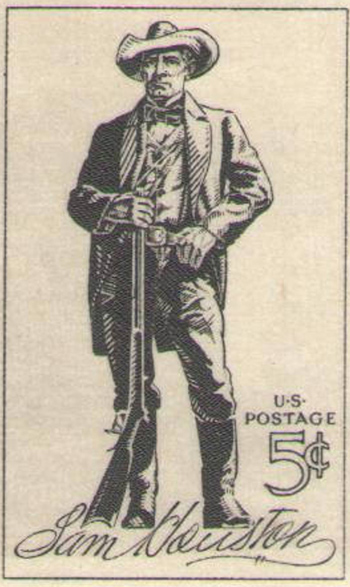
Sam Houston |
||
Early Life and Cherokee InfluenceSam Houston was an American military general and politician who was born in Virginia in 1793. At a young age, Houston ran away from home and spent time with a Cherokee Indian tribe nearby, familiarizing himself with their ways and culture. These experiences in his youth informed his later decisions as a politician. Military Service and Political RiseHouston served in the military during the War of 1812 and caught the attention of then-General Andrew Jackson. Jackson took Houston under his wing, causing Houston to adopt many Jacksonian policies. Houston represented Tennessee in Congress for two terms before being elected its governor. He resigned in 1829 after a divorce and spent a few years in the Cherokee Indians’ territory once more. Move to Texas and the Fight for IndependenceIn 1832, Houston moved to Texas during a time when tensions were high between Texans and the Mexican government. When conflict arose between the Texans seeking independence and the Mexicans tightening their control, Houston became commander of the local Texan army. When war broke out, and the Texans suffered a massive defeat at the Battle of the Alamo, Houston ordered that his forces retreat—a controversial decision, but one that allowed him to train the army for a battle that would later result in a Texan victory. Victory at San JacintoIn 1836, Houston and 800 men camped out on the banks of the San Jacinto River and defeated the much larger forces of Mexican general Antonio Lopez de Santa Anna in a mere 18 minutes. Santa Anna’s defeat led to an armistice that won the Texans their independence, and Houston’s quick thinking was a key factor in that victory. Leadership in the Republic and BeyondAfter Texas became independent, Houston was elected its president for two terms in 1836 and 1841. As president, he tried to avoid future wars with Mexico and to stop conflicts with Native Americans—a decision likely influenced by his past with the Cherokee. He then served as a senator when the United States annexed Texas and fought to preserve the Union as tensions over slavery grew. Later Years and LegacyEventually, Houston’s ideals were rejected by fellow politicians, and he was removed from a secession convention in Texas. He retired from politics and died in Huntsville, Texas, in 1863. Houston was the only American elected governor of two states—Tennessee and Texas—and the city of Houston is named in his honor, recognizing his major role in winning Texan independence.
Early LifeSam Houston was born in Virginia in 1793. As a young man, he ran away and lived with a Cherokee tribe, learning their way of life. This experience shaped his views later in life. Military and Political StartHouston fought in the War of 1812 and became close to General Andrew Jackson. He later served in Congress and became governor of Tennessee. After a divorce, he left politics and went to live with the Cherokee again. Moving to TexasIn 1832, Houston moved to Texas when tensions were rising with Mexico. He became the leader of the Texan army. After the loss at the Alamo, he ordered his troops to retreat so they could regroup and train. Victory for TexasIn 1836, Houston and his army surprised and defeated Mexican General Santa Anna at the Battle of San Jacinto in only 18 minutes. This win helped Texas gain independence from Mexico. President of TexasHouston was elected president of Texas twice. He tried to keep peace with Mexico and Native tribes. After Texas joined the U.S., he became a senator and worked to keep the country together as slavery caused division. Later Years and LegacyHouston was removed from office for not supporting Texas leaving the Union. He retired and died in 1863. He is the only person to be governor of both Tennessee and Texas, and the city of Houston is named after him. |
||
| Sam Houston Activities | ||
|