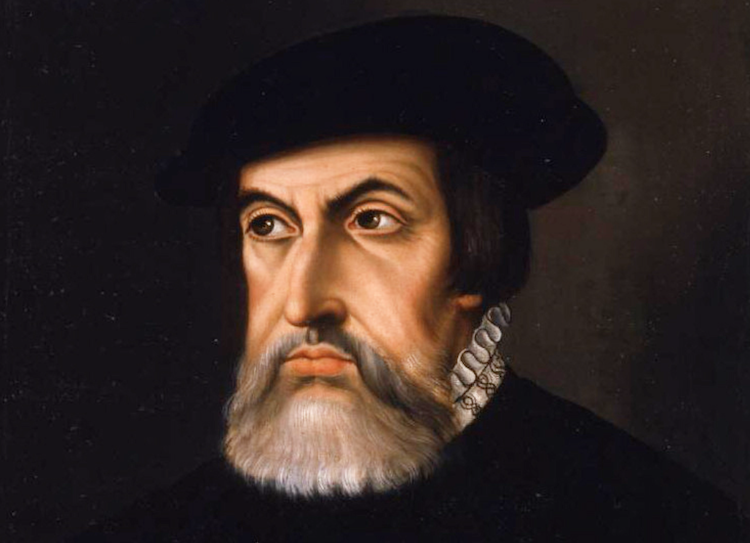
Hernán Cortés |
||||
Early Life and BackgroundHernando Cortés (Hernán Cortés was his real name) was born in Medellín, Spain, around 1485. He was a Spanish conquistador known for conquering the Aztec Empire of Mexico. He came from a noble family and was well-educated. From an early age, however, Cortés was described as a troublemaker—mischievous, quarrelsome, and even ruthless. Excited by tales of the New World, he sailed to Hispaniola in the West Indies at the age of 19. During his stay in Hispaniola, he served both as a farmer and notary (a public official) before embarking on an expedition to Cuba in 1511, led by Diego Velázquez. Cortés proved to be a natural leader and became the mayor of Santiago, Cuba. Expedition to MexicoIn the fall of 1518, he set off for Mexico on his own expedition with 600 soldiers, sailors, and 16 horses on 11 ships. They landed on the Mexican coast in early 1519 at Tabasco on the Yucatán Peninsula, where he and his army defeated a group of natives. While there, Cortés managed to gain favor among other native groups, and he fathered a son with a native woman named Marina, who also served as an interpreter. Cortés next conquered the city of Veracruz. It was at Veracruz where he began making plans to visit Montezuma and the Aztec Empire despite orders from Spain to halt further explorations. On the way to the Aztec capital of Tenochtitlán, Cortés allied with several tribes that were enemies of the Aztecs and massacred others, possibly to instill fear among the Aztecs. Arrival in Tenochtitlán and Conflict with the AztecsOn November 8, 1519, Hernán Cortés and his crew entered Tenochtitlán, where they were initially welcomed into the city with lavish gifts adorned with gold and precious gemstones. Cortés remarked that the island capital of Tenochtitlán was among the most beautiful and advanced cities in the world, although he was horrified by the Aztec practice of sacrificing prisoners of war to their gods. These initial gifts, however, made the Spanish eager for more. Meanwhile, Cortés learned that the Aztecs considered him an emissary (representative) of their central god, Quetzalcoatl. Cortés and his men took advantage of their status and kidnapped the Aztec chief Montezuma, who was later killed. The Spaniards quickly wore out their welcome and managed to escape the island city in the middle of the night. Cortés suffered hundreds of casualties and lost much of the treasure he had looted during the narrow escape. The Spanish, however, initiated the collapse of the Aztec Empire by infecting the Aztecs with smallpox. With the Aztec capital in ruins and the population dying from disease, Cortés returned and founded Mexico City atop the ruins of Tenochtitlán in 1521. He was appointed governor of New Spain in 1522 by King Charles I. Mexico would be ruled by Spain for three centuries following the conquest. Later Years and Final DaysIn 1524, Cortés traveled to Honduras to stop a rebellion against him, and when he returned to Mexico, he found he had been removed from power by Ponce de León, who may have believed that Cortés was becoming too powerful. Cortés went back to Spain to plead his case with the king but was denied his governorship. He eventually returned to the New World, where he explored and named California. He retired in Spain and died in 1547.
Discussion QuestionsEarly Life and BackgroundHernando Cortés was born in Spain around 1485. He came from a noble family and was smart, but often got into trouble. At age 19, he sailed to the New World. He worked on the island of Hispaniola and later joined an expedition to Cuba, where he became the mayor of Santiago. Expedition to MexicoIn 1518, Cortés left for Mexico with 600 men and 11 ships. He fought native people, made allies, and had a son with a native woman named Marina, who also helped him as a translator. He captured the city of Veracruz and ignored Spain’s orders to stop. On his way to the Aztec capital, he made deals with enemy tribes and attacked others. Arrival in Tenochtitlán and Conflict with the AztecsIn 1519, Cortés arrived in the Aztec city of Tenochtitlán. The Aztecs welcomed him and gave him gold, thinking he might be connected to their god. Cortés used this to his advantage and captured the Aztec ruler Montezuma. After fighting broke out, the Spanish escaped but lost many men and treasure. Later, smallpox weakened the Aztecs, and Cortés returned to take over. In 1521, he built Mexico City on the ruins and became governor. Later Years and Final DaysIn 1524, Cortés went to Honduras to stop a rebellion. When he came back, he had lost his power in Mexico. He returned to Spain to ask the king for his title back but failed. He later explored parts of the U.S., including California, and died in Spain in 1547.
|
||||