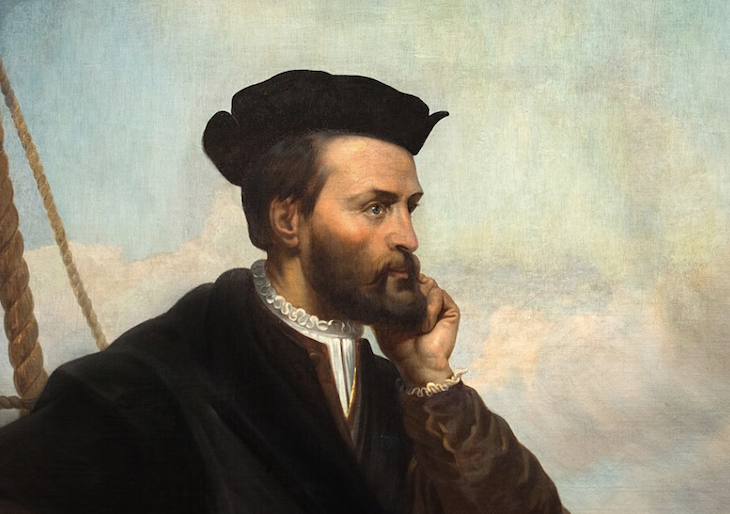
Jacques Cartier |
||||||
Early LifeJacques Cartier was born on December 31, 1491 in Saint-Malo, Brittany, which would later become part of France. His career in exploration began in 1524, when he accompanied the Italian-born French explorer Giovanni da Verrazano on his explorations of the Atlantic Coast of Canada and the United States. The experience would prove valuable to Cartier's explorations in the future. I Know I Found Asia!In 1534, Cartier was commissioned by the King of France to find the fabled Northwest Passage through the continent of North America to Asia (the Indies). When Cartier reached the New World, he sailed around parts of Newfoundland and parts of the Gulf of St. Lawrence. On July 24, 1534, Cartier planted a cross with the words engraved, "Long Live the King of France" on the shores of Gaspe Bay in Quebec. Cartier claimed the region for France and kidnapped the two sons of an Iroquoian chief. Later in 1534, Cartier returned to France, believing he had found Asia. The Search for the Northwest PassageIn 1535, Cartier and 112 men (including the two kidnapped natives) left France for their return trip and sailed up the St. Lawrence River to the Iroquoian capital of Stadacona. He reached the location of modern-day Montreal (then called Hochelaga) on October 2, 1535, where rapids prevented him from continuing. Cartier believed the rapids were the last obstacle in his discovery of the Northwest Passage. Today, the town on the banks of the rapids is called Lachine, the French word for China. Surviving the Winter and Cities of GoldCartier and his crew were forced to spend the winter of 1535-1536 at Stadacona, where the snow was four feet deep. In addition, scurvy broke out among members of Cartier's crew, though most were saved by ingesting a native remedy using the boiled bark of a white spruce tree. In early May of 1536, after enduring a brutal winter, Cartier returned to France with an Iroquoian chief who would tell the tale of the Kingdom of Saguenay, a mythical city said to be full of rubies, gold, and other riches. Paving the Way for New FranceIn 1540, Cartier returned to the New World as captain general of a colonization project. Nevertheless, Cartier set off with five ships down the St. Lawrence River for the purposes of finding the Kingdom of Saguenay and for starting a permanent settlement on the river. The site of the settlement was chosen near present-day Cap-Rouge, Quebec, and named Charlesbourg-Royal. Despite the forts built at the settlement, and the fact that Cartier's men falsely believed they had discovered diamonds and gold, conditions deteriorated rapidly. The settlers had begun to starve and attacks by nearby Iroquoian Indians resulted in the deaths of at least 35 of them. Cartier abandoned the settlement in 1542, and the entire settlement disbanded by 1543. Cartier returned to France and died of an epidemic in 1557. Although he was unsuccessful in establishing a permanent settlement, Cartier's explorations of the St. Lawrence River opened up the interior of Canada to further French exploration and eventual settlement.
Discussion QuestionsEarly LifeJacques Cartier was born on December 31, 1491, in Saint-Malo, Brittany, a region that would later become part of France. He began his career in exploration in 1524 by accompanying the Italian-born French explorer Giovanni da Verrazano on voyages along the Atlantic Coast of Canada and the United States. This experience laid the foundation for Cartier's future expeditions. "I Know I Found Asia!"In 1534, King Francis I of France commissioned Cartier to find a Northwest Passage through North America to Asia. Cartier explored parts of Newfoundland and the Gulf of St. Lawrence. On July 24, 1534, he planted a cross in Gaspe Bay, Quebec, claiming the region for France. He also kidnapped two sons of a local Iroquoian chief. Returning to France later that year, Cartier was convinced he had reached the outskirts of Asia. The Search for the Northwest PassageIn 1535, Cartier returned to North America with 112 men and the two kidnapped natives. He sailed up the St. Lawrence River to Stadacona, the Iroquoian capital, and reached Hochelaga (now Montreal) by October 2. His journey ended at a set of rapids, which he believed to be the final barrier to the Northwest Passage. That spot was later named Lachine, meaning "China" in French, reflecting his mistaken belief. Surviving the Winter and Cities of GoldCartier and his men were forced to winter at Stadacona, where deep snow and scurvy ravaged the crew. Most survived thanks to a native remedy made from the boiled bark of a white spruce tree. In May 1536, Cartier returned to France, bringing with him an Iroquoian chief who spoke of a mythical kingdom called Saguenay, said to be rich with gold and jewels. Paving the Way for New FranceIn 1540, Cartier returned to North America to lead a colonization effort. With five ships, he sailed down the St. Lawrence River to establish a settlement at Charlesbourg-Royal near modern-day Cap-Rouge, Quebec. Despite fortifications and a belief they had found precious minerals, starvation and conflict with Iroquoian peoples led to 35 deaths. By 1543, the settlement was abandoned. Cartier returned to France and died of an epidemic in 1557. Although he failed to found a lasting colony, his exploration of the St. Lawrence River paved the way for future French claims in Canada. |
||||||
| Jacques Cartier Activities | ||||||
|
||||||