Ponce de Leon |
||||||
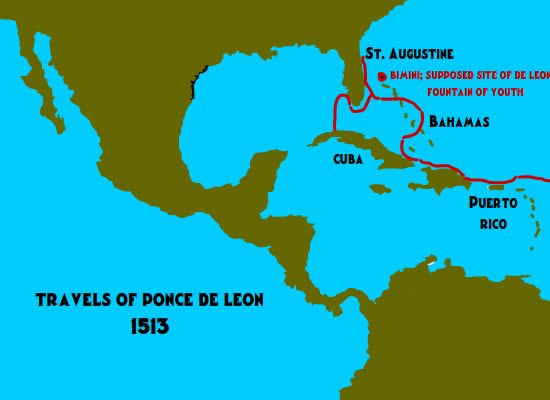
Early LifeJuan Ponce de Leon was born in 1460 in Santervás, Spain. He was an explorer and fighter from an early age and helped fight the Muslims in southern Spain in the early 1490s. He was on board Christopher Columbus’s second expedition to the Americas in 1493. Rather than returning to Spain, the adventurer remained at an island called Santo Domingo (now called the Dominican Republic). The ConquistadorDe Leon was soon appointed as the governor of the Higüey region of Santo Domingo. Like many Spanish explorers, he was bloodthirsty for gold. When he heard rumors that a nearby island called Borinquen (now Puerto Rico) was full of gold, he invaded the island and brutally conquered the natives. He was soon appointed governor of the island but lost his title in 1511 because of his extreme brutality toward the natives. The Search for the Fountain of YouthDe Leon’s misfortunes as governor did not stop him from sailing the seas looking for gold and, according to some legends, the Fountain of Youth. After returning to Puerto Rico, de Leon took three ships and 200 men on a mission to explore lands to the north. De Leon was said to have searched for the Fountain of Youth, a mythical spring that was said to make anyone who drank its water young forever. After making several stops at Caribbean islands and conquering the island of Bimini, de Leon and his men reached the east coast of Florida (St. Augustine) on April 2, 1513. He named the land “Pascua de Florida,” or Feast of Flowers, because he discovered it on Palm Sunday. He claimed all of the land for Spain.
Captain GeneralOn April 8, 1513, de Leon and his men left northern Florida and sailed south along the Gulf Stream. After a fight between his men and natives in southern Florida, he sailed to Cuba. He tried to sail back to Bimini but could not find it. De Leon soon returned to Puerto Rico where he sacked a rebellion of natives against Spanish rule. After returning to Spain, he was named captain general by the king on September 27, 1514. Deathde Leon did not return to the New World until 1521 when he once again tried to find the island of Bimini. Instead, de Leon and his men landed on the Gulf coast of Florida, where they were met by hostile Indians who shot his men with arrows. De Leon himself was wounded and died a short time after sailing to Havana, Cuba, in July of 1521.
Discussion Questions
Early LifeJuan Ponce de León was born in 1460 in Santervás, Spain. As a young man, he fought against the Moors in southern Spain and later joined Christopher Columbus’s second voyage to the Americas in 1493. Rather than returning to Spain, he stayed in the Caribbean on the island of Santo Domingo, now known as the Dominican Republic. The ConquistadorDe León became governor of the Higüey region of Santo Domingo. When he heard rumors of gold on the nearby island of Borinquen (now Puerto Rico), he invaded and conquered the island. Though appointed governor, he lost the title in 1511 due to his harsh treatment of the native people. The Search for the Fountain of YouthDriven by stories of gold and a magical spring called the Fountain of Youth, de León led an expedition north in 1513. After stopping at various Caribbean islands, he landed on the east coast of Florida on April 2, naming it “Pascua de Florida” (Feast of Flowers) because it was Palm Sunday. He claimed the land for Spain. Captain GeneralAfter briefly exploring the coast of Florida and clashing with native groups, de León returned to Puerto Rico. He later went back to Spain, where he was named captain general by the king in 1514 for his service to the crown. DeathIn 1521, de León returned to Florida in another attempt to find Bimini and its legendary fountain. Instead, he and his men were attacked by native warriors. Wounded by an arrow, de León retreated to Cuba, where he died later that year. |
||||||
| Learn More | ||||||
| The Search for the Fountain of Youth | ||||||
| Libel: The False Narrative on Ponce de Leon | ||||||
| Ponce de Leon Activities | ||||||