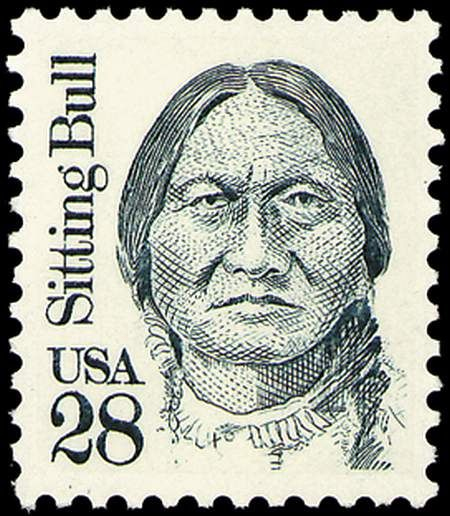
Sitting Bull |
|
Fearsome WarriorSitting Bull was a Lakota medicine man and war chief. He was born sometime around 1831 near Grand River, South Dakota. He was given the name Tatanka-Iyotanka, which is translated to a bull sitting on its haunches. From an early age, Sitting Bull was a fearsome warrior. According to legend, he participated in his first battle at the age of 14, when he joined a party that raided a Crow village. In 1864, Sitting Bull participated in the Battle of Killdeer Mountain, a battle which crushed much of the Lakota resistance to U.S. military forces in the upper Great Plains. Despite the setback, Sitting Bull refused to surrender and live on a reservation and led a successful attack against the newly built Fort Rice in North Dakota in 1865. Sitting Bull’s bravery and refusal to surrender to the Government earned him the title of head chief of the Lakota Nation in 1868. Resisting the U.S. GovernmentIn the 1870’s, Sitting Bull began an effort to unite the various nations of the Great Plains against the rising tide of White settlement in the region. Sitting Bull first tried a peaceful approach to dealing with the White settlers, but the settlers increasingly tricked the Lakota people into making bad land and food deals. After gold was discovered in the Black Hills, a Lakota holy place, Sitting Bull refused to move to reservations designated by the U.S. Government. Instead, he led a group of warriors to take up arms against the settlers and miners. Little Big Horn and Eventual SurrenderIn June of 1876, 3,000 Indian warriors under the command of Sitting Bull repelled an attack by the 7th Cavalry under the command of George Custer at Little Big Horn River, Montana. Sitting Bull’s warriors then launched a brutal counterattack on the cavalry that resulted in the deaths of virtually every American soldier in the cavalry. The event came to be known as Custer’s Last Stand and is probably the most famous battle that took place between the U.S. Government and Native Americans. After the battle, U.S. forces accumulated in the region and forced many in the Lakota tribe to relocate to reservations. Sitting Bull, however, refused and led a group of Lakota Indians into Saskatchewan, Canada. He refused to return to the United States, even though he was issued a pardon. He was eventually forced to surrender, however, in 1881 because of cold and hunger. He was imprisoned for a short time before being sent to a reservation to live. Ghost DancersIn 1885, Sitting Bull was permitted to leave the reservation to join a traveling show called “Buffalo Bill’s Wild West Show.” The show would tour the country and Sitting Bull would ride around the arena shouting curse words at the audience in his native language. Sitting Bull left the show after a couple of months and began earning an income from selling his autographed picture. By 1890, Sitting Bull returned to his Indian roots and joined the “Ghost Dancers,” a large Indian movement involving a “Ghost Dance,” which the participants believed would make them impervious to bullets. The movement quickly gained strength and the U.S. Government began to fear a large rebellion. In an attempt to stop the dancing, the Government tried to arrest Sitting Bull, who they thought was encouraging the practice. When his Sioux brethren tried to interfere in the arrest, gunshots were fired, one of which killed Sitting Bull and another one hit his son, Crow Foot. LegacyToday, Sitting Bull is remembered as one of the greatest figures in Lakota history. He is supposedly buried at Fort Yates, North Dakota, but some in the Lakota tribe claim his remains have been transported to a holy site in South Dakota. Discussion Questions
Fearsome WarriorSitting Bull was a Lakota medicine man and chief, born around 1831 near Grand River, South Dakota. As a boy, he was already a brave fighter and joined his first battle at age 14. In 1864, he fought in the Battle of Killdeer Mountain, and in 1865, he led an attack on Fort Rice. Because of his courage, he was named head chief of the Lakota Nation in 1868. Resisting the U.S. GovernmentIn the 1870s, Sitting Bull worked to unite the tribes of the Great Plains against White settlers. At first, he tried peace, but many settlers tricked the Lakota into giving up land. When gold was found in the Black Hills, he refused to move to a reservation and chose to fight back instead. Little Big Horn and Eventual SurrenderIn 1876, Sitting Bull’s warriors defeated General Custer and the 7th Cavalry at the Battle of Little Big Horn. This became known as “Custer’s Last Stand.” After the battle, many Lakota were forced onto reservations. Sitting Bull went to Canada but later returned and surrendered in 1881 due to hunger and cold. Ghost DancersIn 1885, Sitting Bull joined Buffalo Bill’s Wild West Show but left after a short time. He later joined the “Ghost Dancers,” a religious movement believed to protect Native Americans from harm. The U.S. government feared a rebellion and tried to arrest Sitting Bull in 1890. During the arrest, he and his son Crow Foot were shot and killed. LegacySitting Bull is honored as one of the Lakota's greatest leaders. He is believed to be buried at Fort Yates, North Dakota, although some say his remains were moved to a sacred place in South Dakota. |
| Sitting Bull Activities |
|