Cherokee Nation |
|
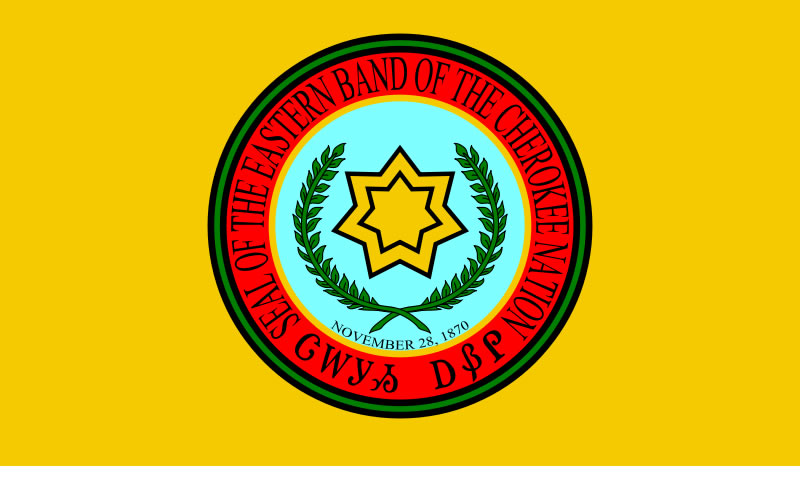
The Cherokee native name is Ani-Yun'wiya, meaning "principal people." The name "Cherokee" is likely derived from the Choctaw word Tsalagi meaning "People of the Land of the Caves." The Cherokees historically inhabited much of eastern Kentucky, North and South Carolina, eastern Tennessee, Georgia, and northern Alabama. Diet:
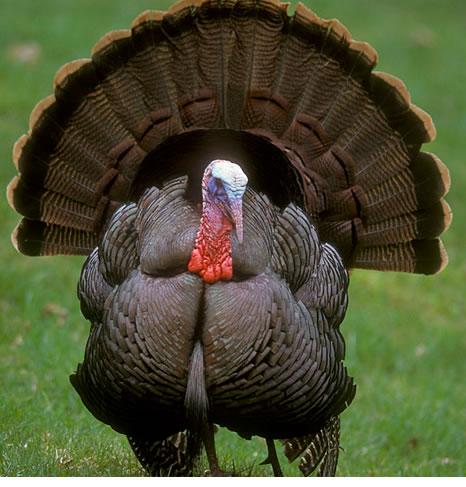
The Cherokee were prolific farmers and grew corn, beans, squash, pumpkins, sunflowers, and tobacco. They grew three different kinds of corn, one for roasting, one for boiling, and one for grinding into flour. They also gathered crabapples, berries, nuts, and other fruits. The Cherokee also hunted for game. Warriors used bows and arrows to kill bear and deer and blowguns to kill turkey, grouse, rabbits, and squirrels. The darts from the blowguns could be used to kill animals from as far away as 60 feet. The Cherokee used hooks and spears to impale fish and sometimes poisoned portions of a creek or stream to bring stunned fish to the surface. Homes:
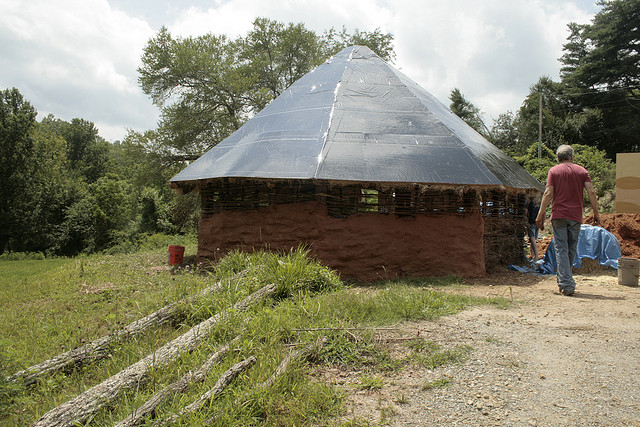
Most Cherokee families had two houses; one for the summer and one for the winter. The summerhouses were rectangular with wooden pole frameworks, clay walls, and thatched roofs. Winter homes were much smaller and were usually built over a fire pit and had cone-shaped roofs. Cherokee villages were well fortified with vertically stacked logs that protected them from hostile tribes. The typical Cherokee village was comprised of about 30-60 homes with one council house where meetings were held and where the sacred fire was burned. Villages typically held between 400-500 people. The Cherokee nation was divided into hundreds of villages, some of which were considered “red,” or warring villages and some of which were considered “white,” or peaceful villages. Culture:
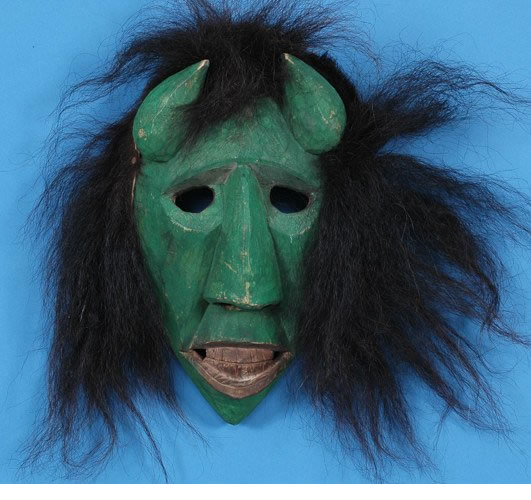
The Cherokee were a dominant tribe that lived in parts of modern-day Tennessee, Georgia, the Carolinas, Alabama and Kentucky. Men and women had specific gender roles: Men were in charge of war, hunting, and diplomatic relations, while females were in charge of the home, property, and family. Sometimes, Cherokee women participated in war too. The Cherokee were divided into seven large clans: Long Hair, Paint, Bird, Wolf, Wild Potato, Deer, and Blue. Babies would be born into their mother’s clan. Villages were comprised of individuals from different clans. A man and a woman from the same clan could not marry. CeremoniesThe Cherokee had many sacred ceremonies including those for their crops, births, deaths, war, moon phases, and other events. The most important Cherokee ceremony was the Green Corn Ceremony, which took place when the last corn crop ripened. The ceremony usually lasted four days and honored, Selu, the Cherokee Corn Mother. At the beginning of the ceremony, all of the members of a village would wash themselves in a source of moving water. Then, sacred dances representing the harvest would be performed for several hours within the sacred circle, a large pit that also included a fire lit with a sacred branch that was struck by lightning. The ceremony would end with various other dances and rituals including one in which the entire village danced around the sacred fire. Booger MasksThe Cherokee practiced a variety of crafts including basketwork, pottery, carved pipe making, and rattle making. Rattles were made out of turtle shells and were used to ward off evil spirits. The Cherokee, however, are perhaps most renowned for their booger masks, colorful masks that represented evil spirits and their enemies. Eventually, these masks came to resemble the faces of the White trespassers. Booger masks were made from wood or hornets nests and were originally made as part of the Booger Dance, a winter celebration that ensured evil spirits could not disrupt the coming growing season. One of the most evil spirits in Cherokee lore was the Raven Mocker, an old, withered looking witch-like character who robbed the living of their lives by eating their hearts. Little PeopleThe Cherokees believed in good spirits as well such as the Little People, a small race of spirits that lived in nearby caves. The Cherokee considered these knee-high spirits kind, hard working, and helpful. The Little People came in all colors and shades and had the power to cast spells. They were given a great deal of respect among the Cherokee and were thought to teach about living in harmony with nature. There were three types of Little People, the Rock People, Dogwood People, and Laurel People. The Cherokee also practiced the sport that evolved into modern-day lacrosse. It was played between members of the same clan, or, between rival villages. Wars:
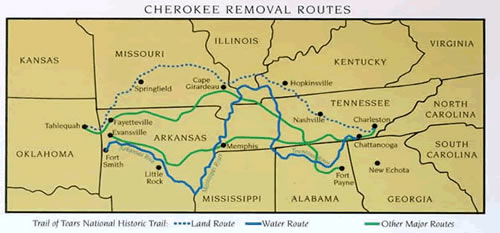
The Chickamauga Wars were a series of battles, ambushes, and massacres staged between Cherokee forces under Dragging Canoe and the many militias comprised of Scotch-Irish settlers in Kentucky, the Carolinas, Tennessee, and Georgia during and after the Revolutionary War. By the 1780's, the Chickamauga Wars had sort of spread and merged with other wars being fought between Indian nations and settlers throughout much of America. Like most of the Indian Wars, the Chickamauga Wars occurred with increased White encroachment on Indian lands. The Chickamauga Wars coincided with the Revolutionary War. As a result, American forces were forced to fight the combined forces of the British, Cherokees, and many other united tribes in the war's southern theater and in the western territories. As the Americans gained ground in the southern colonies, military detachments were sent that annihilated Cherokee villagers, villages, crops, orchards, and livestock along the Chickamauga River in Tennessee and Georgia in 1777 and 1778. While the Cherokees were successful in staging raids and ambushes on settlements and along the various trails established to guide settlers into the region, they were eventually overwhelmed by the American presence and many lost the will to continue the fight. Near the end of the Revolution, Dragging Canoe and his supporters were forced to move west and merge with other tribes to maintain the resistance, without the arms and financing of the defeated British. Meanwhile, other Indian tribes that had banded together fought the settlers in more northern latitudes. The Chickamauga Wars soon spread throughout the south and into the Midwest where the Cherokees, Shawnee, Miami, Muskogee, and dozens of other tribes united in the fight. By the early 1790's, and through the first and second decades of the 19th century, wars, battles, ambushes, and guerrilla warfare between the Indians and settlers scarred much of the interior of America. Tens of thousands of Indians and natives were killed in the skirmishing. Along with Dragging Canoe, many other incredible native leaders emerged in the conflict such as Blue Jacket, Little Turtle, and eventually, the great Shawnee chief Tecumseh. While many nations and tribes resisted for years to come, they were eventually overwhelmed by the sheer number of settlers and the quest for expansion initiated by the U.S. Government. America’s population was booming and spreading west in the early 1800’s. Westward expansion came mostly at the expense of the Indians who were often forced to move from their native lands. In the state of Georgia, the population increased 600 percent in the matter of 40 years. As a result, many of its native tribes were pushed out. The Cherokee Indians, of western Georgia had managed to keep their land until gold was discovered in their territory in 1828. In 1830, however, president Andrew Jackson authorized the Indian Removal Act. The Cherokees fought the law, and it was overturned by chief justice John Marshall two years later. Just three years later, however, in 1835, the Treaty of New Echota was signed. The “Treaty” was not authorized by the Cherokee Nation, but rather, a small group of Cherokee radicals led by John Ridge. Under the “Treaty”, the Cherokee were to leave Georgia and the government would compensate them at a price determined to be about 5 percent of the value of the land. The majority of the Cherokee Nation would never had agreed to the “Treaty”, but the U.S. government ratified it anyway. John Ridge was thus seen as a traitor by the Cherokees – and would later pay with his life. The Georgia government then staged a “land lottery” in which Cherokee land was divided into 160 equal portions. They were sold to anyone who had $4.00 and who had won a chance to own land. In 1838, General Winfield Scott and 7,000 troops invaded Cherokee land. Men, women, and children were forced to walk westward from Georgia nearly 1,000 miles with minimal facilities and food, to reservations set up for them in Oklahoma. Cherokee chief John Ross, eventually was able to convince Winfield Scott that his people should lead the tribe west. Scott agreed and Ross divided the people into smaller groups so they could forage for food on their own. Although Ross may have save countless lives, nearly 4,000 Indians died walking this Trail of Tears. Discussion Questions
Who Are the Cherokee?The Cherokee call themselves Ani-Yun'wiya, which means "principal people." The word "Cherokee" may come from a Choctaw word meaning "People of the Land of the Caves." They lived in parts of Kentucky, Tennessee, the Carolinas, Georgia, and Alabama. Food and HuntingThe Cherokee grew corn, beans, squash, pumpkins, sunflowers, and tobacco. They gathered fruits and nuts and hunted deer, bear, rabbits, and squirrels using bows, arrows, and blowguns. They also fished using hooks, spears, and sometimes plant poison to bring fish to the surface. Homes and VillagesCherokee families had two homes: a larger one for summer and a smaller one for winter. Villages were protected by log fences and had 30–60 homes and one council house. Villages had about 400–500 people and were known as either “red” (warlike) or “white” (peaceful). Culture and ClansThe Cherokee had seven clans: Long Hair, Paint, Bird, Wolf, Wild Potato, Deer, and Blue. People were born into their mother’s clan and could not marry someone from the same clan. Men hunted and went to war; women took care of the home and family. Beliefs and CeremoniesThe most important Cherokee ceremony was the Green Corn Ceremony, held at harvest time. It involved dances, water rituals, and sacred fires. They made crafts like baskets, rattles, and special masks called “Booger Masks” used in dances to chase away bad spirits. They also believed in helpful spirits called the Little People who lived in caves and taught people how to live in peace. Chickamauga WarsDuring and after the American Revolution, the Cherokee fought settlers in battles called the Chickamauga Wars, led by a chief named Dragging Canoe. Although they fought hard, they were eventually pushed back as more settlers came. Many Native groups, including the Cherokee, Shawnee, and others, resisted westward expansion, but were defeated. Trail of TearsAs more settlers moved west, Native lands were taken. In 1830, President Andrew Jackson signed the Indian Removal Act. Even though the Supreme Court ruled in favor of the Cherokee, the U.S. government forced them to leave their land. In 1838, thousands were forced to walk to Oklahoma. About 4,000 died on the journey, now known as the Trail of Tears. |
| Cherokee Activities |
|