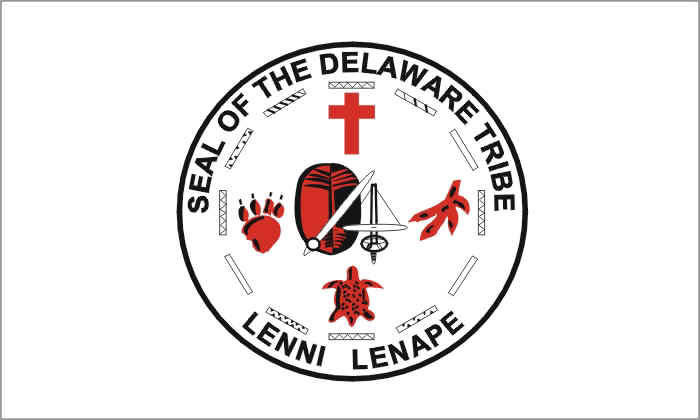
Lenni Lenape Nation |
||
|
||
Name/LocationThe Delaware Indians are often called the Lenni-Lenape Indians. "Lenni-Lenape" means "real people".The Lenni Lenape inhabited southeastern New York state, eastern Pennsylvania, New Jersey, Delaware, and northern Maryland. Most of their villages were located near the Delaware or Susquehanna Rivers. DietLike many of the Eastern Woodland peoples, the Lenni-Lenape were an agricultural people who grew corn, beans, and squash. They also hunted for deer, elk, and turkeys using bows and arrows. HomesThe Lenni-Lenape built villages of round houses called wigwams. Some Lenape Indians, however, built Iroquois-style longhouses in which entire families could live together. CultureLenape Indians were divided into clans (family groups). Clan membership was matrilineal (children inherited clan membership from their mother). Clans lived in stationary villages and used the surrounding land until the resources were exhausted. Lenape men were typically in charge of hunting and protecting their families. Women were in charge of farming, cooking, and taking care of the children. Lenape mothers often carried their babies in cradleboards - boards in which the baby was strapped to and positioned on the mother's back. Children often accompanied their fathers on hunting trips and had their own toys such as miniature dolls and bows and arrows. Older children participated in games similar to modern-day lacrosse and kickball. Lenape men typically wore a breechcloth, a long rectangular piece of cloth tucked between the leg and tucked over the belt, forming flaps in front and in back. Women wore knee-length skirts. Men and women wore earrings and deerskin moccasins. They also painted their faces for different celebrations, and men often had tattoos honoring different animals. Males sometimes had a mohawk hairstyle, or, completely shaved their heads. The Lenni Lenape Indians held many ceremonies. The most important ceremony was known as The Big House. The Big House lasted 12 days and involved a log structure representing the universe, the lighting of a sacred fire, and offerings to a God known as the Guardian of the Game. The purpose of the ceremony was to promote tribal unity, hope for good fortune, and for personal renewal. HistoryThe modern history of the Lenni Lenape people is closely connected with the history and development of the United States. In 1626, members of the Lenni Lenape tribe sold Manhattan Island to Peter Minuet and Dutch settlers for various trinkets, tools, and beads. Manhattan Island would later become the center of America's largest city - New York City. The Lenni Lenape, however, did not believe they were selling the land forever and believed that no one person could "own" land. They thought they were simply selling the rights to use the land. In 1682, the Lenni Lenape signed a treaty of friendship with William Penn and the Quakers in Pennsylvania. The treaty became the first of its kind signed between Europeans and Indians. Negotiation of the treaty is historically credited to Tamanend, a legendary Lenni-Lenape chief known for his peaceful ways. Today, several societies and festivals in Philadelphia and elsewhere are named in his honor. Tammany Hall, a famous political organization in New York City in the 1800's and 1900's, was named for him. In 1778, the Lenni Lenape became the first group of native peoples to sign a treaty with the U.S. government pledging their support in the American Revolution.
Eventually, however, the rapid rate of colonization forced the Lenni Lenape from their lands. Furthermore, the Lenni Lenapes gradually became dependent on European goods. When local resources such as beaver pelts became exhausted, the Lenni Lenape were left with little to offer in trade and quickly declined in population because of disease and alcoholism. In 1766, they were forced to sign the Treaty of Easton, which forced them to move from their ancestral lands to western Pennsylvania and Ohio. Today, some Lenni Lenape descendents live on reservations in Oklahoma, Wisconsin, and Ontario, Canada. Discussion Questions
Who Were They?The Lenni Lenape, also called the Delaware Indians, lived in the areas that are now New York, New Jersey, Pennsylvania, Delaware, and Maryland. Their name means "real people." They often lived near rivers like the Delaware and Susquehanna. FoodThe Lenape grew corn, beans, and squash. They also hunted deer, elk, and turkeys using bows and arrows. HomesMost Lenape lived in round houses called wigwams. Some families lived together in longhouses like those used by the Iroquois. Family and Daily LifeThe Lenape were organized into clans that passed down through the mother. Men hunted and protected the family, while women farmed and raised children. Babies were carried in cradleboards, and children played with dolls and toy bows. Older kids played games like lacrosse and kickball. Clothing and CultureMen wore breechcloths and sometimes shaved their heads or wore mohawks. Women wore skirts. Both men and women wore moccasins, earrings, and painted their faces. The most important ceremony was the Big House, a 12-day event for prayer and unity. HistoryIn 1626, the Lenape sold Manhattan Island to Dutch settlers, but they believed they were only selling the rights to use the land. In 1682, they signed a peace treaty with William Penn. Chief Tamanend became a symbol of peace, and many things were named after him, including Tammany Hall. Over time, colonization forced the Lenape to move west, and their population dropped due to disease and lack of resources. Today, Lenape descendants live in Oklahoma, Wisconsin, and Canada. |