Sioux (Lakota) Nation |
|
|
|
Meaning of NameThe name Sioux has proven difficult to translate. Some contend it represents a small kind of rattlesnake, while others claim it represents "those who speak a foreign language." Still others translate it to "enemy" or "mysterious voice." The name Sioux is the collective name of the Lakota (Santee), Dakota (Yankton), and Nakota (Teton) tribes. RangeThe Dakotas, particularly the Black Hills of South Dakota, were the heart of Sioux territory. In addition, the Sioux inhabited other parts of the northern Great Plains including parts of Minnesota, Wisconsin, Iowa, Nebraska, eastern Montana and eastern Wyoming.
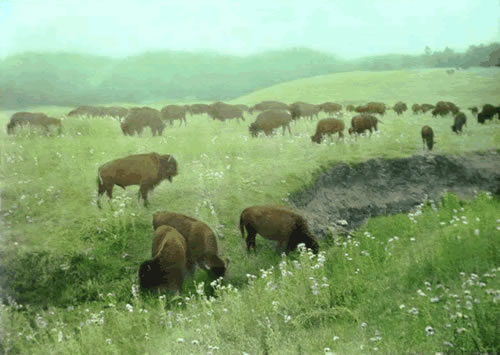
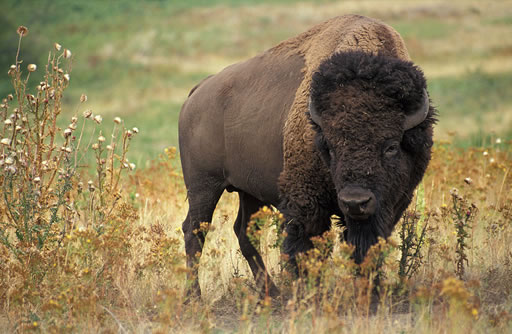
DietHome is where the Buffalo RoamThe great herds of buffalo that roamed the plains were essential for all parts of Sioux life and society. For most Sioux villages, “home” was wherever the herds of buffalo roamed.
Before the introduction of the horse, Sioux warriors would hunt the buffalo by dressing up as wolves as tricking them into running off of cliffs and ledges. They would also dress up in buffalo skins and make crying sounds like a baby buffalo. When an adult buffalo went to investigate, the warriors would kill it with spears and arrows. Using the Entire BuffaloThe Sioux Indians used the entire buffalo following a kill. The buffalo hide was used for making teepes, clothes, moccasins, and robes. The hair was used to make rope and the horns were used as cups and dishes. Children fashioned sleds out of buffalo ribs, and buffalo fat was used as glue. Most importantly, buffalo meat provided food for the entire village. Much of the buffalo meat that was collected was cooked, dried, and pounded into pemmican (sort of like modern-day beef jerky). Culture
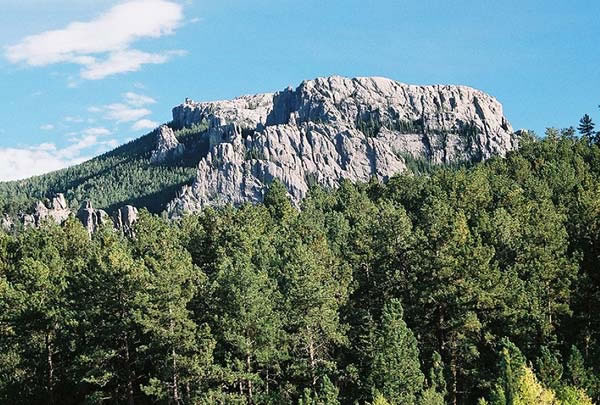
Black Hills, S.D. Gender RolesIn the Sioux culture, men were the providers and women tended to the home and cooked. In fact, the home belonged to the woman, and she was in charge of every aspect involved in caring for and maintaining it. Since there were often more women in a village than men, many Sioux men had several families and killed enough buffalo to feed them all. ChildrenChildren were thought of as sacred in Sioux culture and were rarely punished. When they were punished, the adult usually confiscated an item that was loved. Adults often hung “dream catchers” above the cradles of their children to “catch” bad dreams” in the web. WarfareOnly men could become “chiefs” in Sioux society. Unlike in some Native American tribes, however, the title of “chief” was earned rather than inherited. Sioux warriors used bows and arrows, clubs, and spears when hunting or defending the tribe. “Fighting” between Indians was often non-violent and usually involved stealing horses, or proving bravery. Spiritual BeliefsLike most tribes, the Sioux were very spiritual. They believed in Wakan Tanka (The Great Mystery of The Thunderbird), a God who created all living things. Wakan Tanka lived in a grand tepee in the Black Hills of South Dakota, one of the most sacred areas in Sioux culture. The Sioux also believed in the spirit of the White Buffalo Calf Maiden. This spirit first appeared to the Sioux in human form but was actually a white buffalo calf. She taught the Sioux lessons to avoid ignorance, evil, and self-destruction. She also introduced the sacred pipe, which was the center of seven secret ceremonies performed during times of religious persecution. Among these ceremonies was the Sweat Lodge Ceremony, in which Sioux villagers purged themselves of guilt, burden, and evil, by smoking the pipe in a “sweat lodge” ( a dome-shaped tent made of willow branches, furs, nd hides with a fire pit in the center) before an important event. The ceremony was also thought to bring its participants closer to Wakan Tanka. Another ceremony was known as The Vision Quest. In a Vision Quest, an individual would purify himself in the sweat lodge before isolating himself on a mountaintop, forest, or desert without food. The object of the Vision Quest was to help the participant seek oneness with all living things and to learn about his future in the form of a vision. The participant would then communicate his vision to the village shaman (medicine-man) who would interpret it. Based on the interpretation, a medicine bundle (a bag of tokens and items that had special meanings to the owner) would be prepared with various items to represent the guiding spirit. This is a just a small sampling of Sioux spiritual beliefs. It is important to note that there were many more spiritual ceremonies that may be interpreted in a variety of ways. Wars
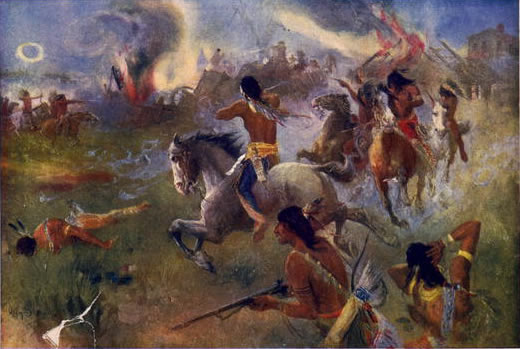
Siege at New Elm America Expands at the Expense of the SiouxAs America expanded in a westward direction in the middle part of the 1800’s, the Sioux nation was forced to cede much of their land to the United States government. In 1851, the two sides signed the Treaty of Traverse des Sioux and Treaty of Mendota, which gave the government control of much of the Minnesota territory. As part of the treaty, the Sioux agreed to live on a twenty-mile wide reservation on the upper Minnesota River and the U.S. government agreed to make regular payments and deliver food and goods to the Sioux. Former Sioux lands were quickly developed, which disrupted Sioux hunting, fishing, and planting. In addition, the great herds of buffalo that thundered through the plains just 100 years before were virtually gone. Violent ConflictsAs the promises made by the U.S. Government in the treaties of 1851 remained unfulfilled, and a terrible famine struck Minnesota, starving members of the Sioux nation lashed out against the settlers in August of 1862. Led by Chief Little Crow, the Sioux nation began attacking settlements and killing settlers. The killings quickly escalated and spread into other parts of Minnesota. For six weeks, intense fighting between the Sioux and settlers raged throughout Minnesota. The violence was finally quelled after Abraham Lincoln appointed General John Pope to assemble troops and suppress the Sioux. At least 500 soldiers died in the conflict as well as several hundred settlers and even more Sioux. 38 Sioux warriors were ultimately convicted of war crimes and hanged in Mankato, Minnesota . The hanging remains the largest public execution in the history of America. None of the executed even had attorneys to represent them. After the hanging, the U.S. Government declared the former treaties with the Sioux null and void, abolished their reservation, and took measures to expel them entirely from Minnesota. Red Cloud's WarThese measures, however, hardly led to any cease-fire. Fighting between the Sioux and U. S. government would continue for almost thirty years. In 1862, the same year of the Minnesota Uprising, government forces and Sioux warriors clashed in Red Cloud’s War. Red Cloud’s War arose over the continued trespassing of White settlers in Sioux land. Gold had recently been discovered in Montana and Wyoming, and thousands of would-be prospectors used the Bozeman Trail to connect with the Oregon Trail. In 1865, the Sioux began attacking wagon trains along the trails. Despite the presence of U.S. military patrols, the Sioux, led by Crazy Horse, used guerilla warfare in hundreds of attacks on the patrols and wagon trains. Eventually, the U.S. government agreed to abandon forts built on the trails if the Sioux stopped their raids. The Sioux celebrated by burning down the forts. Little Big Horn and the Massacre at Wounded KneeThe Sioux won more victories over the U.S. Army in various battles in the Black Hills of South Dakota and Wyoming. In perhaps the most famous battle in all of the Indian Wars, Sioux and Cheyenne Indians obliterated the entire Seventh Calvary under George Custer at the Battle of Little Big Horn in 1876. The infamous battle, in which the entire 250-man cavalry was killed, is known as Custer’s Last Stand. Further battles, however, proved disastrous for the Sioux and other Plains tribes. U.S. government forces soon overwhelmed the tribes of Plains, and dealt them a final blow during the Massacre of Wounded Knee of 1890. In the last battle of the Indian Wars, as many as 300 Sioux were killed as they believed their “Ghost Shirts” would protect them from government bullets. The government, alarmed by the increasing number of Sioux that had taken up arms (and who had been performing forbidden “ghost dances,”) initiated the first shots when a gun accidentally discharged. Discussion Questions
Meaning of the NameThe name Sioux may mean "rattlesnake," "enemy," or "those who speak a foreign language." It refers to three groups: the Lakota, Dakota, and Nakota tribes. HomelandThe Sioux lived in the Great Plains, especially in the Black Hills of South Dakota. They also lived in parts of Minnesota, Iowa, Nebraska, Montana, and Wyoming. Diet and BuffaloThe Sioux followed buffalo herds, which were essential for food, clothes, shelter, and tools. They used every part of the buffalo. Before they had horses, they used clever tricks to hunt buffalo. Culture and Daily LifeMen hunted and fought, while women took care of the home. Children were respected and protected. Dream catchers were used to keep away bad dreams. Chiefs were chosen based on skill and bravery. Spiritual BeliefsThe Sioux believed in Wakan Tanka, the Great Spirit. They held many ceremonies like the Sweat Lodge and Vision Quest. These rituals helped them feel closer to nature and their creator. Conflicts with the U.S. GovernmentIn the 1800s, the U.S. pushed west and took Sioux land. Treaties were signed but often broken. The loss of land and buffalo caused great hardship for the Sioux. Uprisings and WarsIn 1862, the Sioux attacked settlers in Minnesota due to broken promises and famine. Many were killed and 38 Sioux were hanged in a mass execution. Later, Red Cloud's War and other battles followed as settlers continued to take Sioux land. Famous BattlesThe Sioux defeated Custer at the Battle of Little Big Horn in 1876. But they lost more battles later, including the tragic Massacre at Wounded Knee in 1890, marking the end of Sioux resistance. |
|
| Sioux Activities | |
|