The Battles of Lexington and Concord |
||
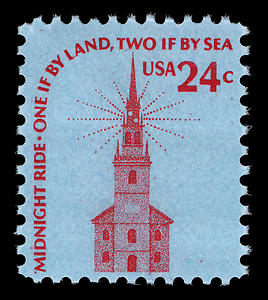
Following resolutions made by the Continental Congress, armed conflict seemed imminent. King George, who declared the colonies in a state of rebellion, had authorized the deliverance of British soldiers to reinforce those who had occupied Boston since 1768. General Thomas Gage was sent to Boston to disarm the colonists and arrest the leaders of the rebellion, namely John Hancock and Samuel Adams. After learning of the existence of a large colonial arsenal in Concord, about 20 miles northwest of Boston, General Gage sent a detachment of 700 troops under Colonel Francis Smith to march to Concord for the purposes of seizing and destroying artillery and ammunition. The Colonists, however, already knew their weapons were in jeopardy and had moved most of them to secret locations before the arrival of the Redcoats. Paul Revere's Midnight RideAs British troops mobilized in Boston, Dr. Joseph Warren alerted members of the Sons of Liberty - Paul Revere and William Dawes. Dawes promptly rode to Concord to warn Hancock and Adams and Revere rode through the countryside yelling "The Regulars are Coming" or "The Regulars are Out." By dawn, about 70 armed minutemen (Massachusetts militia) had gathered in the Lexington town common awaiting the arrival of the Redcoats. Gage's own wife, Margaret Kemble Gage, is thought to have given Warren information about her husband's planned raid in sympathy to the Revolution. Learn More About Margaret Kemble Gage's Possible Giveaway
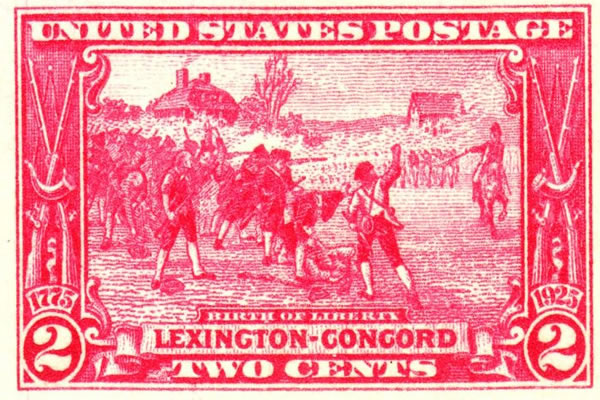
At Lexington - The Shot Heard Round the WorldWhen the British arrived on the scene, someone fired a shot that would become known as "The Shot Heard Round' the World." To this day, historians disagree on which side fired first, or, if the shot came from a spectator. Nevertheless, the Redcoats subsequently unleashed devastating volleys before charging the minutemen with their bayonets. As the Redcoats marched on to Concord, eight minutemen were killed and ten wounded. Nevertheless, the numbers of Minutemen arriving from surrounding towns swelled and the substantial militia retreated to a ridge about a mile from Concord across the North Bridge. The Devastating March from Concord to BostonMeanwhile, British troops had occupied Concord, destroyed several cannons, and burned leftover ammunition. A gun battle erupted as the two sides crossed at the North Bridge. In a stunning turn of events, the Minutemen held the bridge, forcing the Redcoats to retreat. As the Redcoats exited Concord on their way back to Boston, hundreds or even thousands of farmers and other colonial workers had positioned themselves behind trees, rocks, in pastures, under bridges, and in places they could not be seen by the Redcoats, firing at them as they marched on. Desperate Redcoats, frustrated by an enemy they could not see, and in revenge for the brutal scalping of one of their dead, sometimes pillaged houses and communities along the way, killing dozens of colonists. Colonial militias, however, continued to snipe away the lines of Redcoats. By the time they finally had made it back to Boston, 73 Redcoats were killed and 174 were wounded. The American Revolution had officially begun. After the Continental Congress made strong decisions, war seemed likely. King George declared the colonies were in rebellion and sent more British troops to Boston. General Thomas Gage was told to arrest rebel leaders like John Hancock and Samuel Adams, and to take weapons from the colonists. He heard that weapons were being stored in Concord, so he sent 700 soldiers led by Colonel Francis Smith to find and destroy them. But the colonists had already hidden most of the weapons in secret places.
Paul Revere's Midnight RideAs British troops got ready to leave Boston, Dr. Joseph Warren warned the Sons of Liberty. Paul Revere and William Dawes rode to warn the colonists. Revere shouted, “The Regulars are coming!” On the Lexington town green, about 70 armed colonists waited for the British. Some believe General Gage’s wife, Margaret, may have secretly told Warren about the British plans. The Shot Heard Round the WorldWhen the British reached Lexington, a shot was fired—no one knows who fired first. The British then fired volleys and charged with bayonets. Eight colonists were killed and ten were wounded. More Minutemen arrived and moved to a hill near Concord, across the North Bridge. The March Back to BostonIn Concord, the British destroyed some weapons. At the North Bridge, the colonists fought back and forced the British to retreat. On their way back to Boston, British soldiers were attacked by colonists hiding behind trees and fences. The British sometimes struck back, burning homes and killing colonists. By the time they returned to Boston, 73 British soldiers were dead and 174 were wounded. The American Revolution had begun. |
||
| Battle of Lexington and Concord Activities | ||
|