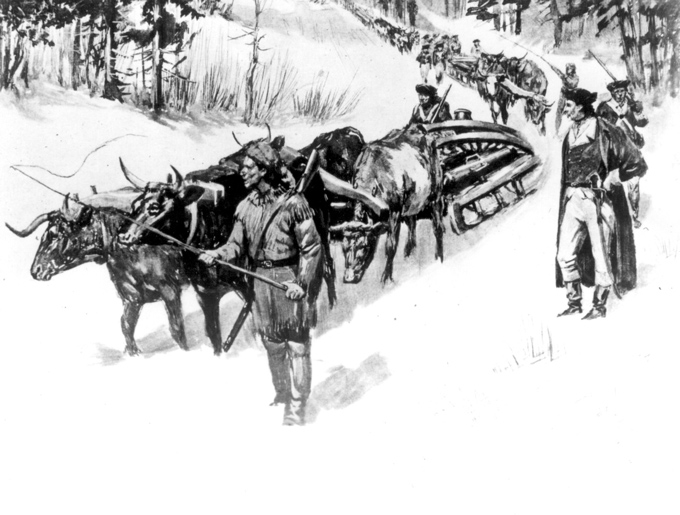
Noble Train of Artillery |
Weapons From Fort TiconderogaOn May 10, 1775, Benedict Arnold, Ethan Allen, and the Green Mountain Boys, conducted a successful raid of Fort Ticonderoga. The bloodless raid yielded an incredible cache of weapons for the fledgling Patriot cause. There was a problem, however. Fort Ticonderoga was located in remote upstate New York, where the weapons were of little use. How could the Patriots transport the heavy weaponry 300 miles to break the British blockade of Boston Harbor? Learn more about Fort Ticonderoga Knox Placed in Charge of Moving 60 Tons of Weapons Nearly 300 MilesThat same year, Commander-in-Chief George Washington was put in charge of Patriot forces in Boston. Recognizing a need for heavy weaponry, Washington chose the 25-year-old bookseller, Henry Knox to lead the expedition to transport the weapons to Boston. On December 5, 1775, Knox reached Fort Ticonderoga. Knox's first assignment was to evaluate the weapons and to determine which would be transported. Knox chose 59 different weapons, including several large cannons called "Big Berthas." In all, the load of weapons was estimated to weigh 60 tons. Learn more about Henry Knox The Arduous ProcessMuch of what is known about Knox's journey comes from his largely incomplete and tattered diary. On December 17, Knox wrote to Washington that he was on his way to Boston and had procured 42 sleds and 80 "yoke" of oxen. By Christmas Day, Knox had crossed the icy Hudson River near Albany, although two feet of snow slowed his progress. It took an additional two weeks for Knox and his team to usher all of the cannons across the river. In the process, several cannons fell through the ice and were retrieved. Although details within Knox's diary are sketchy, he apparently crossed the Berkshire Mountains in western Massachusetts and reached Framingham, Massachusetts, on January 25. Knox had reached the outskirts of Boston at Cambridge two days later. The entire journey, dubbed "one of the most stupendous feats of logistics" in the Revolutionary War, took a total of ten weeks. Positioning the WeaponsOn March 4, 1776, Patriot soldiers occupied Dorchester Heights, a series of low hills overlooking Boston. Washington ordered the cannons captured from Fort Ticonderoga to be positioned on the heights, threatening the British fleet in the harbor below. Under the cover of darkness, 2,000 Patriot soldiers under the command of John Thomas, and supervised by George Washington, painstakingly moved cannons into place, built makeshift fortifications, cleared trees, and built rock-filled barrels that could be rolled down the hills in case of a British attack. Giant hay stacks were strategically placed to quiet the noise of the preparations. The British Evacuate BostonWhen the British realized what had occurred, they made plans to attack the hill to dislodge the Patriots. Their plans, however, were thwarted by a powerful snowstorm, which gave British General William Howe time to reconsider this action. On March 17, 1776, General Howe instructed his soldiers and fleet to leave the city of Boston and its harbor. The British withdrew to Halifax, Nova Scotia, and Boston was safe for the time being.
On May 10, 1775, Benedict Arnold, Ethan Allen, and the Green Mountain Boys captured Fort Ticonderoga without a fight. They found many weapons, but the fort was far from where the weapons were needed. The big challenge was how to move them 300 miles to Boston to help fight the British. Knox Put in ChargeGeorge Washington, the leader of the Patriot army, chose 25-year-old Henry Knox to move the weapons. Knox arrived at Fort Ticonderoga on December 5, 1775, and picked out 59 weapons, including large cannons. Altogether, the weapons weighed about 60 tons. The Difficult JourneyKnox used 42 sleds and 80 oxen to carry the weapons. Snow and ice made the trip very hard. Cannons even fell through the ice but were saved. He crossed the Hudson River and the Berkshire Mountains. Knox reached the edge of Boston on January 27. The journey took 10 weeks and is seen as an amazing achievement in moving supplies during the war. Setting Up the CannonsOn March 4, 1776, Patriot soldiers took over Dorchester Heights, which looked down on Boston. They moved the cannons into position during the night. They also built defenses, cut down trees, and used hay to muffle the sounds of their work, all without alerting the British. The British Leave BostonWhen the British saw the cannons aimed at them, they planned to attack. But a snowstorm stopped them. British General William Howe then decided to leave. On March 17, 1776, the British army and navy left Boston and sailed to Halifax, Nova Scotia. Boston was safe—for now. |
| Noble Train Activities |
|