The Seizure of Fort Ticonderoga |
||
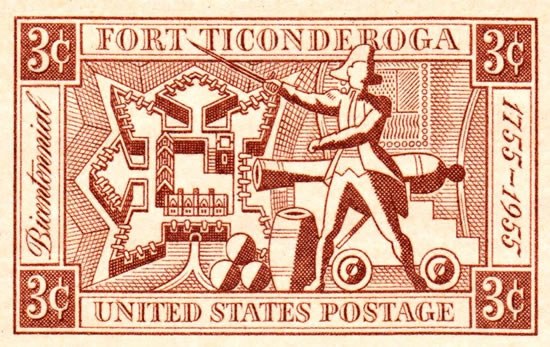
Fort Ticonderoga was a small, dilapidated British fort maintained by the British at the southern tip of Lake Champlain in upstate New York. It was a strategically important fort in the French and Indian War, and was known then as Fort Carillon.
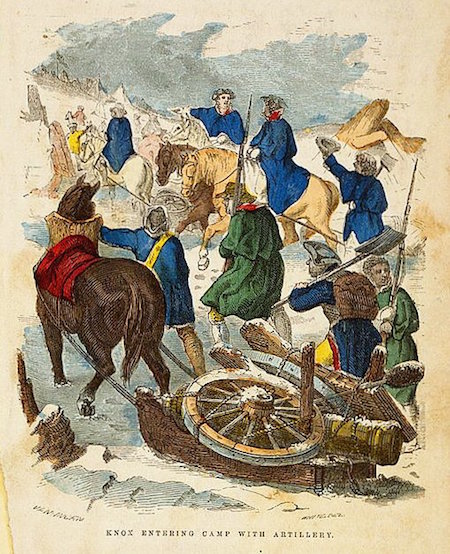
Why was it important?Although it was manned by only 48 British soldiers, American forces recognized its geographic importance and its cache of cannon, guns, and other weapons. Fort Ticonderoga was located in a strategically important route between the colonies and England's Northern provinces (today Canada). The Massachusetts Committee of Safety authorized a secret mission that would be led by Colonel Benedict Arnold to seize the fort. Arnold helped in the effort to recruit 400 soldiers. A Bloodless SeizureAs Arnold's mission traveled north, he learned that Connecticut had also planned a mission to seize the fort that was led by Ethan Allen and his Green Mountain Boys from Vermont. When Arnold finally reached Allen, the two worked out an agreement to share command of the mission. On May 10th, 1775, Allen, Arnold and 83 soldiers raided Fort Ticonderoga. The British soldiers, sleeping inside the fort, offered no resistance. No one was killed in the raid. After the surrender, as many as four hundred additional American soldiers arrived at the fort, promptly destroying it in search of liquor. Arnold was infuriated by the lack of discipline and regard by the Green Mountain Boys. Several of them became so sick of Arnold that they apparently drew their swords. Ethan Allen would take credit for the entire operation. Learn More About: Arnold is Relieved of his CommandOn May 11, Arnold led the seizure of nearby Fort Crown Point , which yielded more weapons and cannons. The first of Arnold's many perceived snubs occurred when he was relieved of command of the fort by Benjamin Hinman, who had come with 1,000 troops to help rebuild it. Weapons Hauled 300 Miles to BostonDespite Arnold's disappointment, the weapons obtained from the seizures of Forts Ticonderoga and Crown Point would prove extremely useful to the American cause. Commander-in-Chief of Continental forces, George Washington, put Colonel Henry Knox in charge of transporting the weapons for the defense of Boston. Knox and his men dragged 59 cannons on ox-drawn sleds over 300 miles from Fort Ticonderoga, through Albany, N.Y. and the mountains of Massachusetts, to Boston. The trip took 56 days. The entire load weighed more than 60 tons. When the cannons arrived in Boston, Washington ordered them positioned atop Dorchester Heights, overlooking the British fleet in the harbor below. On the night of March 4, 1776, Dorchester Heights would be fortified by 1,200 soldiers and the cannons were moved into place - all of which went unnoticed by the British. The British, astonished by the enormity of the work completed by the Patriots, were eventually forced to leave Boston and sail back to British territory in Halifax, Nova Scotia (Canada).
Learn More About Henry Knox's Journey (The Nobel Train of Artillery)
Fort Ticonderoga was a small, old British fort at the southern tip of Lake Champlain in New York. It was important during the French and Indian War and was once called Fort Carillon. Why was it important?Even though only 48 British soldiers were there, American forces wanted the fort for its weapons and strategic location between the colonies and Canada. The Massachusetts Committee of Safety secretly sent Colonel Benedict Arnold to take it, with help from 400 soldiers. A Bloodless SeizureAs Arnold moved north, he found out Ethan Allen and the Green Mountain Boys from Vermont were also planning to take the fort. Arnold and Allen agreed to share command. On May 10, 1775, they and 83 soldiers surprised the British, who surrendered without a fight. Later, more American soldiers arrived and caused chaos in the fort. Arnold was upset with the lack of discipline. Allen later took credit for the raid. Arnold is Relieved of his CommandOn May 11, Arnold led an attack on Fort Crown Point and got more weapons. But soon, Benjamin Hinman arrived with 1,000 men and took over command, marking the first of many times Arnold felt overlooked. Weapons Hauled 300 Miles to BostonEven though Arnold was disappointed, the weapons from the forts were important. George Washington told Colonel Henry Knox to bring the weapons to Boston. Knox and his men hauled 59 cannons on sleds over 300 miles. It took 56 days and the load weighed over 60 tons. On March 4, 1776, the cannons were placed on Dorchester Heights, surprising the British. The British eventually left Boston and sailed to Halifax, Canada. |
||
| Fort Ticonderoga Activities | ||
|