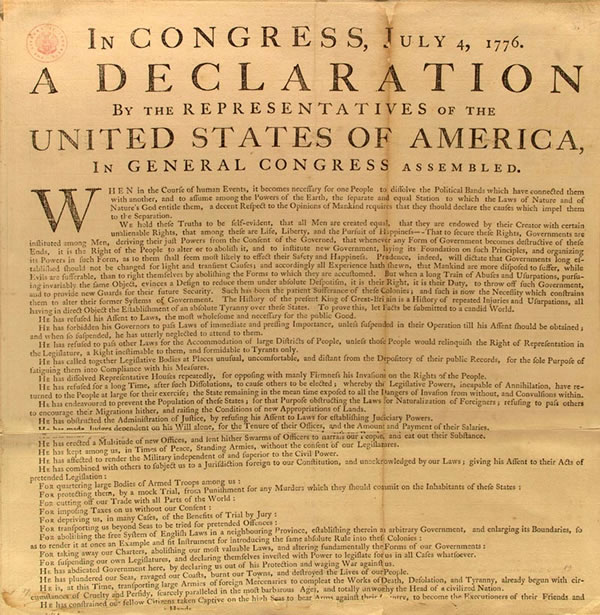
Declaration of Independence |
||
Written for the Powers of the WorldThe main purpose of America's Declaration of Independence was to explain to foreign nations why the colonies had chosen to separate themselves from Great Britain. The Revolutionary War had already begun, and several major battles had already taken place. The American colonies had already cut most major ties to England and had established their own congress, currency, army, and post office. On June 7, 1776, at Independence Hall in Philadelphia, Richard Henry Lee voiced a resolution that the United States should be completely free of England's influence, and that all political ties between the two countries should be dissolved. Congress agreed and began plans to publish a formal declaration of independence and appointed a committee of five members to draft the declaration. Explaining that Parliament had Failed the PeopleThomas Jefferson was chosen to draft the letter, which he did in a single day. Four other members—Roger Sherman, Robert Livingston, Benjamin Franklin, and John Adams—were part of the committee to help Jefferson. In the Declaration of Independence, Jefferson explained that a body of people has a right to change governments if that government becomes oppressive (unfair and controlling). He further explained that governments fail when they no longer have the consent of the governed. Since Parliament clearly lacked the consent of the American colonists to govern them, it was no longer legitimate. Learn more about: Thomas Jefferson | Benjamin Franklin | John Adams | Roger Sherman Approved and SignedThe Declaration was presented to the Continental Congress in Philadelphia, Pennsylvania, on July 2, 1776. It was approved with a few minor changes. Of the 56 signers of the Declaration of Independence, John Hancock, of Massachusetts, was the first. Learn more about John Hancock | Try the John Hancock Challenge!!
Discussion Questions
Glossary
The main reason for writing the Declaration of Independence was to explain to other countries why the American colonies were separating from Great Britain. The war had already started, and many battles had happened. The colonies had already created their own government, money, army, and mail system. On June 7, 1776, in Philadelphia, Richard Henry Lee said the colonies should be completely free from British control. Congress agreed and formed a group to write the declaration. Learn more about the City of Philadelphia Explaining Why Parliament FailedThomas Jefferson wrote the first draft in just one day. He worked with four other men—Roger Sherman, Robert Livingston, Benjamin Franklin, and John Adams. In the Declaration, Jefferson said people have the right to change their government if it becomes unfair. He said that the British government no longer had the support of the American people, so it was not valid anymore. Approved and SignedThe Declaration was shown to the Continental Congress on July 2, 1776. It was approved with a few small edits. John Hancock from Massachusetts was the first to sign it, followed by 55 other leaders. |
||
| Declaration of Independence Activities | ||
|