New Jersey Colony |
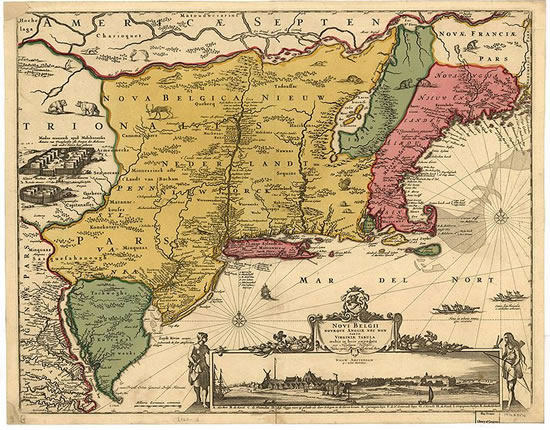
New NetherlandNew Jersey’s early colonial history is similar to New York’s. Like New York, the area was first colonized by Dutch settlers around 1613. The colony was called New Netherland, and included parts of modern-day New York and New Jersey. In 1660, the town of Bergen became the first established town in the New Jersey portion of New Netherland. Today, it is a large city named Jersey City. Between the Hudson and Delaware RiversBy 1664, the British had claimed the entire region and had driven the Dutch out. New Netherland was renamed New Jersey and New Amsterdam was renamed New York. Although King Charles originally gave the region to his brother, the Duke of York, eventually, he decided to divide the region and gave the land between the Hudson and Delaware River (New Jersey) to two of his friends, Sir George Carteret and Lord Berkeley of Stratton. Religious Freedom for a QuitrentCarteret and Berkeley began attracting people to the area by offering land and guaranteeing religious freedom. In return for the land, the settlers were supposed to pay a yearly tax called a quitrent. The quitrents proved hard to collect, which prompted the sale of the land to the Quakers in 1673. Upon the sale, New Jersey was divided in West Jersey and East Jersey. However, by 1702, the two divisions were united as the royal colony of New Jersey. Discussion Questions
Glossary
New NetherlandNew Jersey was first settled by the Dutch around 1613 as part of the colony called New Netherland, which also included parts of New York. In 1660, the town of Bergen became the first town in what is now New Jersey. Today, it is called Jersey City. British ControlIn 1664, the British took control from the Dutch and renamed the colony New Jersey. The land was first given to the Duke of York, who later gave it to his friends, Sir George Carteret and Lord Berkeley. The land between the Hudson and Delaware Rivers became New Jersey. Freedom and LandCarteret and Berkeley offered land and religious freedom to attract settlers. In return, settlers were supposed to pay a small yearly tax called a quitrent. The tax was hard to collect, so they sold the land to the Quakers in 1673. The colony was split into West Jersey and East Jersey, but in 1702, it was united as one royal colony. |
| New Jersey Colony Activities |
|