Rhode Island Colony |
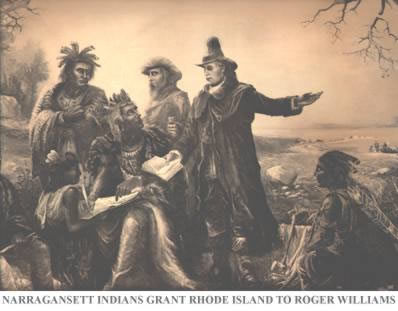
Roger WilliamsLike many English Puritans, Roger Williams came to Massachusetts as part of "The Great Migration", the Puritan departure from England and arrival in the new world. When Williams arrived, however, he realized that the Puritan church had not severed all of its ties with the Church of England, and hence, was not pure enough. For this reason, he refused to fill the position of minister in the church of Boston. Williams became even more controversial when he declared the colony's charter or land-grant invalid because it was not issued by the true owners of the land - the Indians. Williams soon moved to Salem and generated even more controversy by preaching against the taxes that paid church expenses and laws that made attending church mandatory. Progressive ViewsDespite his Puritan ties, Williams' own intolerance of the rules, laws and customs of the Puritans caused him, incidentally, to preach for religious tolerance. He argued against the Puritans laws that controlled the populations. He was one of the first to call for the separation of church and state - a law which now forbids the government to use any religion to influence the people. Escape and EstablishmentThe intolerant Puritans often made a point to suppress individuals with divergent views. They feared people like Roger Williams could influence the people and ultimately threaten the church. In the fall of 1635, they voted to banish him. Before the henchmen reached his home, however, Williams ventured off himself toward Narragansett Bay in January of 1636. After many weeks of traveling through the wilderness of New England, Williams purchased land from the local Indians and founded the town of Providence. Williams devised a compact that allowed all residents to vote regardless of their religion. Furthermore, he encouraged religious sects unpopular with the church to settle in Providence. In March of 1644, Williams did receive a charter from the English Parliament. Under his charter of 1647, Providence, Newport, Warwick, and Portsmouth united to eventually form the colony of Rhode Island.Discussion Questions
Glossary
Roger Williams ArrivesRoger Williams came to Massachusetts during the Great Migration, when many Puritans left England to settle in America. He refused to become a minister in Boston because he believed the Puritan church was still too connected to the Church of England. Progressive ViewsWilliams believed in religious freedom and did not agree with laws that forced people to attend church or pay taxes to support it. He was one of the first people to support the idea of separating church and government. Escape and a New SettlementIn 1635, Puritan leaders voted to banish Williams because they thought his ideas were dangerous. Before they could arrest him, he escaped into the wilderness. He bought land from local Native Americans and started a town called Providence in 1636. People of any religion could live there and vote. Rhode Island is BornIn 1644, Williams received official permission from England to form a colony. By 1647, the towns of Providence, Newport, Warwick, and Portsmouth joined to form the colony of Rhode Island, where people could live with true religious freedom. |
| Rhode Island Activities |
|