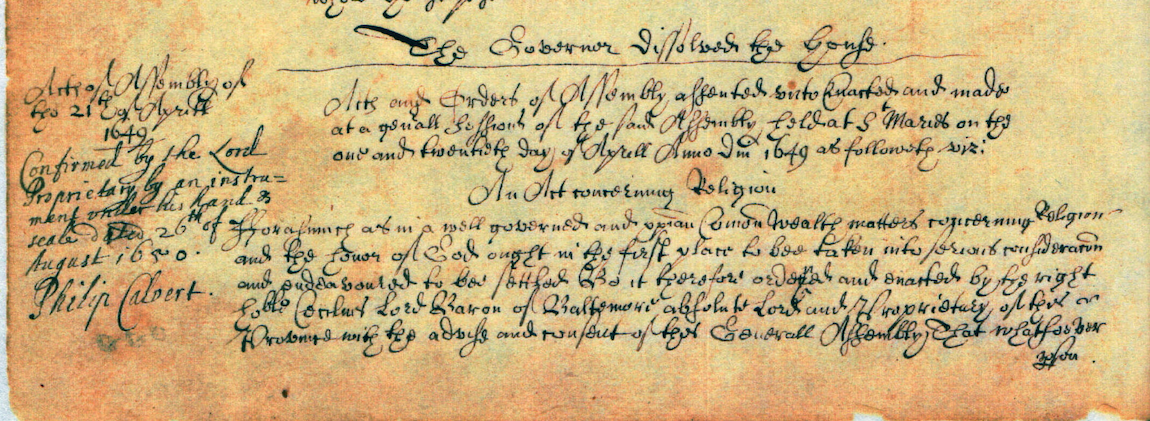
Maryland Toleration Act |
IntroductionIn the turbulent landscape of colonial America, where religious persecution and intolerance were common, the Maryland Toleration Act of 1649 was one of the first laws enacted to provide a limited protection for religious freedom. Historical ContextMaryland, originally founded as a refuge for persecuted Catholics, had become embroiled in religious tensions between Catholics and Protestant settlers. The act was passed in response to growing pressure from Puritan settlers and the English government to impose religious conformity and suppress Catholicism in the colony. In 1692, however, Protestant Puritans gained control of Maryland and repealed the Maryland Toleration Act, and banned the public practice of Catholicism. The ban would remain in effect until the end of the American Revolution. Key ProvisionsThe Maryland Toleration Act, formally titled "An Act Concerning Religion," was a landmark piece of legislation that guaranteed religious freedom and tolerance to all Christians living in the colony. Key provisions of the act included Freedom of Worship:The act guaranteed the right of all Christians to worship according to their conscience and beliefs without fear of persecution or discrimination. Protection of Religious Practices: The act protected the rights of individuals to observe the Sabbath and participate in religious ceremonies and rituals according to their own traditions. Tolerance for Different Christian Denominations: The act extended religious tolerance not only to Catholics but also to other Christian denominations, including Protestants such as Puritans and Quakers. Penalties for Blasphemy and Heresy: While the act promoted religious tolerance, it also included provisions for the punishment of blasphemy and heresy, reflecting the prevailing religious attitudes of the time. It subjected non-Christian denominations to punishments that included execution, although there are no records of the dispensation of such punishments. Significance and LegacyThe Maryland Toleration Act was a pioneering piece of legislation that laid the groundwork for the principle of religious freedom in America. It represented a departure from the religious intolerance and persecution that had characterized much of European and colonial history and set a precedent for the protection of religious liberty in the New World. Influence on American DemocracyThe Maryland Toleration Act had a profound influence on the development of religious freedom and pluralism in America. It served as a model for other colonial charters and constitutions, including the Rhode Island Royal Charter (1663) and the Pennsylvania Frame of Government (1682), which also guaranteed religious freedom and tolerance to their inhabitants. Discussion Questions
Glossary
IntroductionIn colonial America, many people were treated unfairly because of their religion. The Maryland Toleration Act of 1649 was one of the first laws to offer some protection for religious freedom. Historical ContextMaryland was started as a safe place for Catholics. But over time, more Protestants moved there, and tensions grew. The law was passed to calm these tensions and allow all Christians to live peacefully. However, in 1692, Protestants took over the colony and ended the law. They even banned public Catholic worship until after the American Revolution. Key Provisions of the Law
Significance and LegacyThe Maryland Toleration Act was an important step toward religious freedom in America. It showed that people with different Christian beliefs could live together peacefully. Even though the law was later overturned, it helped inspire future laws that protected freedom of religion. Influence on American DemocracyThis act influenced other colonies, like Rhode Island and Pennsylvania, to also allow religious freedom. It helped shape America's belief that people should be free to practice their religion without fear. |
| Maryland Toleration Act Activities |
|