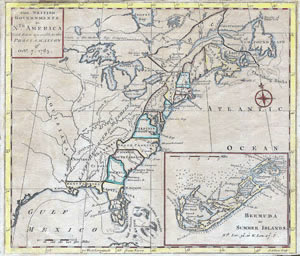
The Royal Proclamation of 1763 |
What was the Purpose of the Royal Proclamation of 1763?Issued on October 2, 1763, the Royal Proclamation of 1763 was intended to regulate the lands west of the Appalachian Mountains awarded to the British in the Treaty of Paris. In the proclamation, portions of the newly acquired land were organized into the large districts of Quebec, East Florida, West Florida, and Grenada. In these territories, Parliament encouraged the issuance of land-grants to veterans of the French and Indian War. Settlement Forbidden in Newly Won LandsThe Proclamation also called for conciliatory actions toward the Indians. Land-Grants were forbidden "beyond the Heads or Sources of any of the Rivers which fall into the Atlantic Ocean from the West and North West." In other words, British settlers were forbidden to settle west of the Appalachian Mountains. Those who had already settled in such lands were forced to relinquish their property. In addition, private purchases of the land from Indians were prohibited, and all issues involving land in the western territories were to be handled by Parliament. Settlers Ignored the ProclamationThe Proclamation of 1763 was extremely unpopular with the colonists and fur traders. Many simply ignored it. In 1768, Parliament acquired additional lands from the Iroquois Confederacy in modern-day western New York, Pennsylvania, West Virginia, and Kentucky as part of the Treaty of Fort Stanwix for the purposes of settlement. Main Ideas
Why It MattersThe Royal Proclamation of 1763 was one of the first major disagreements between the British government and the American colonists. It showed how colonial and British goals were starting to clash. The anger it caused helped lay the groundwork for the American Revolution just a few years later. Discussion Questions
Glossary
The Royal Proclamation of 1763 was one of the first major disagreements between the British government and the American colonists. It showed how colonial and British goals were starting to clash. The anger it caused helped lay the groundwork for the American Revolution just a few years later. What Was the Royal Proclamation of 1763?The Royal Proclamation of 1763 was a law made by the British king on October 2, 1763. It was meant to help control the new lands that Britain gained after winning the French and Indian War. The law created new areas called Quebec, East Florida, West Florida, and Grenada. The British government also planned to give some of this land to soldiers who had fought in the war. No Settling West of the Appalachian MountainsThe Proclamation said that colonists could not move west of the Appalachian Mountains. These lands were to be kept for the Native American tribes. People who had already moved west had to leave. Also, colonists were not allowed to buy land directly from the Indians. Only the British government could make land deals in the west. Colonists Ignored the RulesMany colonists and fur traders did not like this rule and ignored it. In 1768, Britain made a new deal called the Treaty of Fort Stanwix with the Iroquois tribe, letting settlers move into parts of New York, Pennsylvania, West Virginia, and Kentucky. |
| Proclamation of 1763 Activities |
| The Worst Rule Ever - This fun prompt requires students to relate to how the colonists must have felt after the passage of the Royal Proclamation of 1763, by writing about the worst rule they've ever had to follow. |