Comparing and Contrasting Pilgrims and Puritans |
|
IntroductionThe colonization of New England in the 17th century saw the arrival of two distinct groups of English settlers: the Pilgrims and the Puritans. While both sought religious freedom in the New World, they held differing beliefs and practices that shaped their experiences in the Massachusetts Bay Colony. Origins and MotivationsThe Pilgrims, also known as Separatists, were a religious sect that broke away from the Church of England in pursuit of greater religious autonomy. Seeking refuge from persecution, they fled to the Netherlands before embarking on the Mayflower voyage to Plymouth in 1620. The Puritans, on the other hand, remained within the Church of England but sought to reform it from within. Motivated by a desire to purify the church of perceived Catholic remnants, they established the Massachusetts Bay Colony in 1630 under the leadership of John Winthrop. Religious Beliefs and PracticesThe Pilgrims held separatist beliefs, rejecting the authority of the Church of England and emphasizing individual conscience and direct communion with God. They practiced congregationalism, a form of church governance in which each congregation was autonomous and made its own decisions. The Puritans, while also advocating for church reform, maintained a hierarchical structure within the church and emphasized the importance of communal worship and adherence to strict moral codes. Social and Political StructureThe Pilgrims established a small, tight-knit community in Plymouth, characterized by democratic principles and a spirit of cooperation. Their governance structure, outlined in the Mayflower Compact, provided for collective decision-making and individual rights. In contrast, the Puritans of the Massachusetts Bay Colony created a more structured and authoritarian society, with power concentrated in the hands of church leaders and elected officials. They sought to create a "city upon a hill," a model Christian community that would serve as an example to others. Relations with Native AmericansBoth the Pilgrims and the Puritans encountered indigenous peoples upon their arrival in New England, but their interactions differed significantly. The Pilgrims maintained relatively peaceful relations with the Wampanoag tribe, forming alliances and engaging in trade. In contrast, the Puritans' relationship with Native Americans was marked by conflict and distrust, leading to the outbreak of several wars, including King Philip's War in 1675-1676. Discussion Questions
In the 1600s, two groups of English settlers came to New England: the Pilgrims and the Puritans. Both came for religious freedom, but they had different beliefs and ways of life. These differences helped shape life in the Massachusetts Bay Colony. Origins and MotivationsThe Pilgrims were Separatists who left the Church of England. They first moved to the Netherlands, then sailed to America on the Mayflower in 1620. They started the Plymouth Colony. The Puritans stayed in the Church of England but wanted to improve it. In 1630, they came to New England and founded the Massachusetts Bay Colony, led by John Winthrop. Religious Beliefs and PracticesPilgrims believed in individual religious choices and had simple churches where each group made its own decisions. Puritans wanted church rules and order. They believed in strict behavior and community worship led by church leaders. Social and Political StructureThe Pilgrims created a small, close community in Plymouth. They made decisions together and signed the Mayflower Compact to guide their government. The Puritans built a more organized colony where leaders had more power. They wanted to build a perfect Christian society, which they called a “city upon a hill.” Relations with Native AmericansThe Pilgrims worked peacefully with the Wampanoag people and traded with them. The Puritans, however, often had conflicts with Native Americans. One major conflict was King Philip’s War in 1675–1676. |
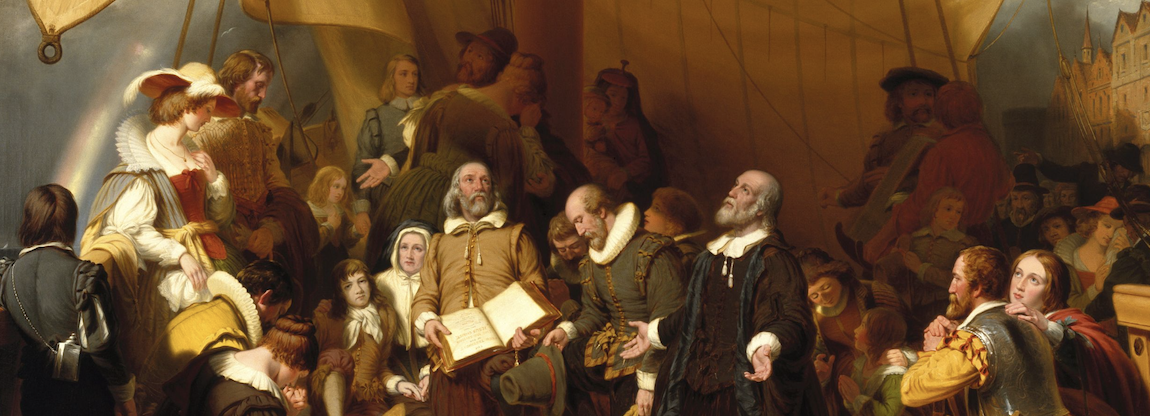 Pilgrims on the Mayflower