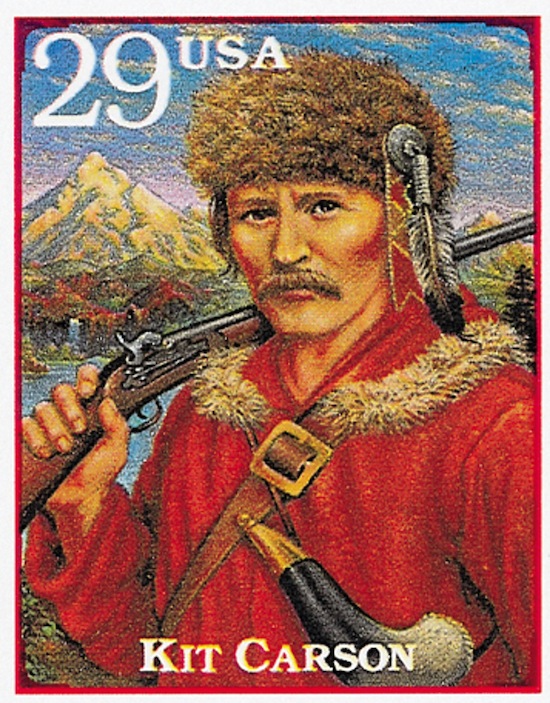
Kit Carson |
Early LifeChristopher "Kit" Carson was born on December 24, 1809, in Madison County, Kentucky. As a young boy, his family moved west to Missouri, where he was raised on the edge of the American frontier. After his father’s death, Carson left home at the age of 16 to become a trapper, eventually learning the ways of the wilderness and becoming fluent in Spanish and several Native American languages. His survival skills and knowledge of the western territories made him a respected mountain man and scout. Explorer and GuideCarson’s reputation grew when he served as a guide for the famed explorer John C. Frémont during several expeditions in the 1840s. These expeditions mapped large portions of the American West, including parts of California, Oregon, and the Great Basin. Carson played a crucial role in helping Frémont’s teams navigate dangerous terrain and maintain peaceful (and sometimes not-so-peaceful) interactions with Native American tribes. Military Career and the Indian WarsDuring the Mexican-American War (1846–1848), Carson served with the U.S. military and helped secure California for the United States. Later, he was appointed an Indian agent, working to manage relationships between Native American tribes and the U.S. government. However, Carson’s role in the Indian Wars was controversial. He led military campaigns against several tribes, including the Navajo. In 1864, he carried out orders to destroy Navajo homes and crops, forcing thousands of Navajo on the “Long Walk” to a distant reservation in New Mexico—a tragic event in Native American history. Learn more about the Long Walk and Navajo Wars Later Years and LegacyCarson also served as a brevet brigadier general during the American Civil War, commanding troops in the Southwest. Though often portrayed as a heroic frontiersman in dime novels of the 19th century, modern historians offer a more complex view, recognizing both his contributions to westward expansion and his involvement in harsh government policies toward Native Americans. DeathKit Carson died on May 23, 1868, in Fort Lyon, Colorado. His life remains a symbol of the rugged American frontier, marked by adventure, conflict, and the expansion of the United States across the continent. Discussion Questions
Early LifeKit Carson was born on December 24, 1809, in Kentucky. His family moved to Missouri when he was young. After his father died, Carson left home at 16 to work as a trapper. He learned survival skills and several Native American languages, becoming known as a skilled mountain man. Explorer and GuideIn the 1840s, Carson became famous as a guide for explorer John C. Frémont. He helped map parts of the West, including California and Oregon. Carson's knowledge of the land and its people made him a valuable guide. Military and Indian WarsCarson helped the U.S. Army during the Mexican-American War. Later, he worked as an Indian agent and led attacks during the Indian Wars. In 1864, he followed orders to destroy Navajo homes and farms, forcing thousands to walk to a faraway reservation. This was called the "Long Walk" and is remembered as a sad event in history. Later YearsCarson also served in the Civil War and became a general. Many stories made him into a hero, but today people also remember the harm caused during his campaigns against Native Americans. His life shows both the excitement and the cost of westward expansion. DeathKit Carson died on May 23, 1868, in Colorado. He is remembered as a symbol of the American frontier and the challenges of settling the West. |