Navajo Nation |
|
The word "Navajo" actually originated from the Spanish, who called the Dineh people Apache de Navajo to distinguish them from the Apaches. The Navajos called themselves "Dineh," or, "The People." The Navajo lived in the desert southwest near the four corners region of Colorado, Utah, New Mexico, and Arizona. DietThe Navajo farmed squash, beans, and corn. Corn was the most important Navajo crop and could be eaten fresh or dried. They also grew melons and pumpkins. The Navajo hunted for deer, antelope, rabbits, prairie dogs and other animals. In later times, they raised sheep for wool and meat. Homes
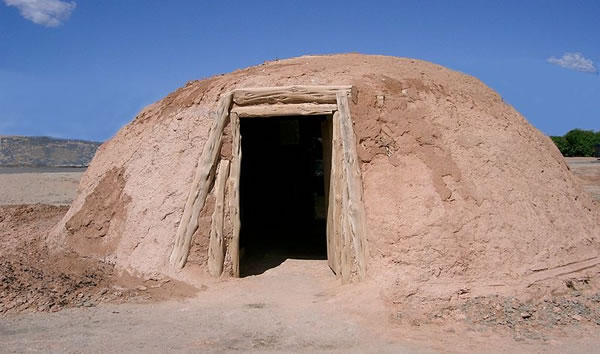
In early times, the Navajo lived in small family groups rather than in villages. They lived in hogans – dark, gloomy structures made of tree bark and mud. The door of the hogan always faced east toward the rising sun, and had a small hole at the top of the dome to allow smoke to escape. Most Navajo families maintained a hogan in the desert and a hogan in the mountains so they could move quickly if the weather turned, the water supply dried up, or new grazing land was needed. Culture
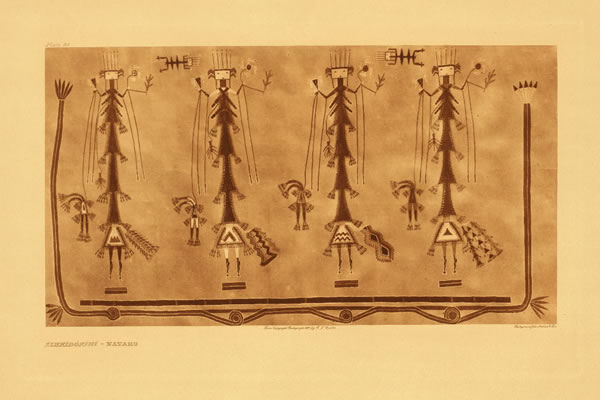
Navajo culture is reflected in artwork and religious ceremonies. The Navajo people are famous for their beautiful silver jewelry. Navajo silversmiths fashioned belts, necklaces, earrings, and rings from silver. They also used silver to create “ketohs” – specialized braces placed upon the wrist to protect it from the backsnap of a bow. Ketohs allowed the archer to shoot arrows with precision. Navajo artists also made colorful blankets from wool. "Holy People"The Navajo people held many interesting religious ceremonies and celebrations. Most of their ceremonies were held to restore harmony. The Navajo believed in good and evil, but that evil could take over if the universe was not in harmony. Ceremonies were held to honor the “holy people” of Navajo culture such as Coyote, Changing Woman, and the Corn People. Sings and BlessingwaysA “sing” was one of the most important Navajo ceremonies. In a sing, a medicine man might perform an old, complicated song and dance designed to restore harmony, heal the sick, protect a family, promote the growth of crops, or protect a village’s herds. The sing was always dedicated to one of the “holy people.” A “blessingway” was a ceremony in which something was requested of the “Holy People.” The request could be as simple as a blessing over a newborn baby or newly conceived marriage, or, for protection against enemies in a pending raid. The Navajos believed that the “Holy People” would grant their requests if they approved of the blessingway, or, if they were displeased, evil spirits could interfere. Sand PaintingsThe Navajos made “sand paintings” as part of a Sing or Blessingway. A sand painting was a large picture made on the floor of a hut made of different colored sands that were carefully crafted between the second and third fingers. The pictures could be ten or twelve feet long and told of magical stories or characters with super powers. Sand paintings were made in the hopes of healing people. Such paintings were destroyed before nightfall so that evil spirits could not infiltrate them. Traditionally, sand paintings were made by medicine men who wished to restore harmony toward a sick person. After the sand painting was finished, the “patient” sat on it and hoped that the powers of the “holy people” could be absorbed. After the ceremony, the sand painting was considered poisonous because it absorbed an illness or disease. Warfare
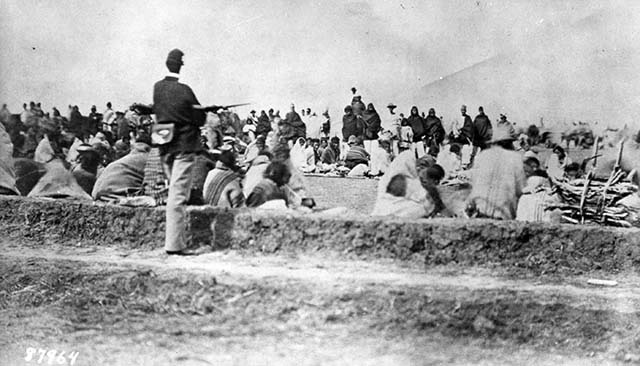
The Navajo and Apache were both aggressive tribes that frequently raided nearby Pueblo settlements for food, property, women, and slaves. In the 1700’s and early 1800’s, Navajo warriors frequently raided Mexican settlements for food, livestock, and slaves in response to Spanish and Mexican warlords who conducted raids and on Navajo villages and kidnapped their children. Navajo warriors also attacked westward-bound settlers on the Santa Fe Trail in the 1840’s. Fort Defiance and Fort LyonIn the 1850’s and 1860’s, after much of the desert southwest was ceded to America as a result of the Mexican War, tensions between the Navajo and the United States military increased. Frequent skirmishes over grazing land, horses, and stolen livestock culminated when the famous Navajo chief Maneulito led his warriors on an attack on Fort Defiance, a military post at Canyon Bonito, New Mexico in 1860. Led by Colonel Edward Canby, the U.S. military succeeded in driving the Navajo warriors back into the rugged terrain of their sacred homeland – Canyon de Chelly. In 1861, ten Navajo rioters were killed at Fort Lyon by U.S. military forces over a horse race in which the Navajo claimed a U.S. soldier cheated in. Kit Carson's Total WarfareBy 1863, the relationship between the Navajo and U.S. military was beyond repair. The government has decided to rid the territory of the Navajo by appointing General James Carelton to drive them from New Mexico. Carleton put Christopher “Kit” Carson in charge of the plan, and Carson subsequently destroyed Navajo land, crops, orchards, and hogans; stole their livestock, and trapped them within Canyon de Chelley in 1863 and 1864. After about nine months, 12,000 half-starving Navajo were forced to surrender to the U.S. Government. It was the largest surrender in all of the Indian Wars. The Navajo were forced to relocate to a reservation in eastern New Mexico, where thousands died of disease, starvation, and fights with Apaches. In 1868, however, a delegation of Navajo chiefs successfully argued their case to the U.S. Government, and was awarded 3.5 million acres of land in their ancestral homeland. Today, the Navajo is the largest tribe in America and have the most reservation lands. Discussion Questions
Name and LocationThe Navajo call themselves the Diné, which means "The People." They lived in the desert Southwest near the Four Corners area of Colorado, Utah, New Mexico, and Arizona. DietThe Navajo farmed corn, beans, squash, melons, and pumpkins. They hunted deer, antelope, and rabbits, and later raised sheep for wool and meat. HomesThe Navajo lived in homes called hogans, made from bark and mud with doors facing east. Families often had two hogans—one in the desert and one in the mountains—so they could move as needed for water or grazing land. Culture and BeliefsNavajo culture includes beautiful silver jewelry, woven wool blankets, and ceremonies to keep the world in balance. They believed in "Holy People" like Coyote and Changing Woman and held ceremonies like Blessingways and Sings to ask for health, protection, and harmony. Sand PaintingsSand paintings were made during healing ceremonies using colored sand to tell sacred stories. Patients sat on them to receive healing, and the paintings were destroyed before nightfall to keep away evil spirits. Warfare and RaidsThe Navajo sometimes raided Pueblo and Mexican villages, especially after being attacked themselves. In the 1800s, they also clashed with American settlers and soldiers over land and resources. Conflict with the U.S. GovernmentIn the 1860s, after many battles, the U.S. Army forced thousands of Navajo to surrender and move to a reservation far from their homeland. Many died during this time, but in 1868, the Navajo were given land in their original territory, where they still live today. TodayThe Navajo Nation is the largest Native American tribe in the United States and has the most land of any tribe. |