Wampanoag Nation |
|
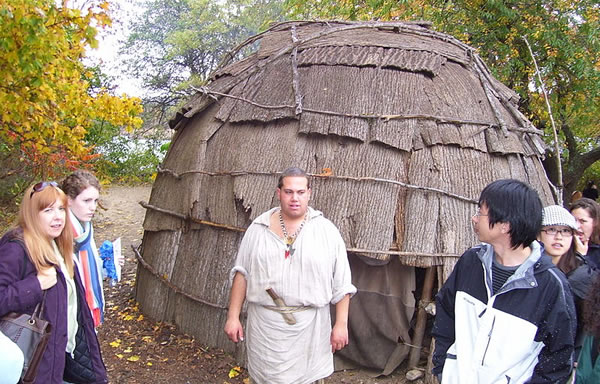
The name "Wampanoag" means Eastern People. The Wampanoag inhabited parts of southern and eastern Massachusetts. Name/LocationThe name "Wampanoag" means Eastern People. The Wampanoag inhabited parts of southern and eastern Massachusetts. DietDiet primarily consisted on the three sisters: corn, beans, and squash. The Wampanoags also fished for fish, clams, and lobster. HomesThe Wampanoags lived in wigwams. A wigwam is a small, domed home built by native groups of the northeast. Wampanoags called their wigwams wetu. The wetu was a seasonal structure that was built to withstand bad weather. They were usually made by felling and bending saplings over a circle drawn on the ground, forming arches. Another set of saplings was then wrapped around the first layer, giving the structure support before the sides and roofs (made of bark) were built. Wigwams were not only built by the Wampanoag, but by many native groups such as the Apache of the American southwest and the Ojibwe of Minnesota.
Wigwam at Plimoth Plantation Image Credit: Swampyank at en.wikipedia.org CultureThe Wampanoags were generally sedentary but moved inland in the winter and closer to the coast in spring. Boys were taught from an early age how to hunt and girls were taught how to maintain the family's wigwam and to tend to the crops. Women were responsible for a significant portion of food production. The Wampanoags were organized into confederations led by a single sachem, or political leader. The head sachem would preside over other sachems that were in charge of their villages. Sachems were in charge of organizing trade alliances and protecting their villages. Both males and females could serve as sachems. HistoryThe history of the Wampanoags before colonization is poorly known. It is thought that an epidemic may have decimated the population between the years of 1616-1619. In 1620, it was the Wampanoags, including Squanto, who taught the hapless Pilgrims how to farm the land, catch fish, and survive the winter. America's first Thanksgiving occurred in November of 1620 and commenced with a huge feast shared by the Pilgrims and the Wampanoags. It is important to note that many experts call into question the idea that the Wampanoags celebrated in such a way with the Pilgrims. Learn more about: Plymouth Colony | The First Thanksgiving As the English population grew in Massachusetts in the 17th century, the Wampanoag culture declined. The Puritans had converted thousands of Wampanoags to Christianity and thousands more had become alcoholics. Relations between Wampanoags resistant to continued English settlement and English colonists became tense and culminated in King Philip's War in 1675. Led by the Wampanoag chief Metacom, (known as Philip to the English), thousands of natives from different tribes began burning English settlements to the ground, including Providence, Rhode Island, and Springfield, Massachusetts. At first, the alliance of natives was successful in its battle, but soon, was overwhelmed by the settlers. Learn more about: King Phillip's War Discussion Questions
Name and LocationThe word "Wampanoag" means "Eastern People." They lived in southern and eastern parts of what is now Massachusetts. DietThe Wampanoag people grew corn, beans, and squash, also known as the “Three Sisters.” They also fished for clams, lobster, and other seafood. HomesThe Wampanoag lived in small, dome-shaped homes called wigwams, or wetu. These homes were made by bending saplings into arches and covering them with bark. Wetus were strong enough to handle bad weather and were used by other tribes too. CultureThe Wampanoag stayed in one area most of the year, moving inland in winter and toward the coast in spring. Boys learned to hunt and girls learned to help with crops and take care of the home. Women played a big role in growing food. The Wampanoag were led by sachems, or chiefs. A main sachem was in charge of many smaller village sachems. Both men and women could be sachems, and they helped organize trade and protect their people. HistoryBefore the Pilgrims arrived, a disease may have reduced the Wampanoag population. In 1620, the Wampanoag, including Squanto, helped the Pilgrims survive by teaching them to grow crops and fish. A feast that year became known as the first Thanksgiving, though historians question how the Wampanoag truly felt about it. As more English settlers came, Wampanoag culture declined. Many were forced to convert to Christianity, and others suffered from alcohol use. In 1675, Chief Metacom (called King Philip by the English) led a war against the colonists. The natives were first successful, but were eventually defeated. |
| Wampanoag Activities |
|