Boston Tea Party and Intolerable Acts |
Boston Tea Party and Intolerable Acts Power Point | Detailed Lesson Plan |
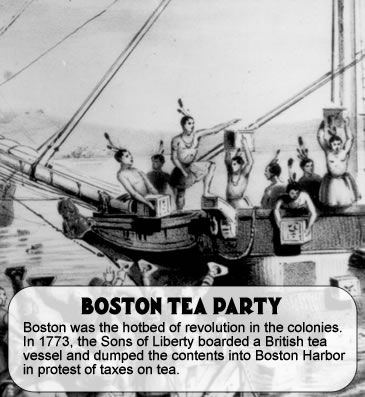
Despite the peace that temporarily reigned in Boston, the Sons of Liberty were continually trying to find ways to keep Parliament' s power over them in check. Furthermore, the tax on tea became more and more irritating. The Dreadful Monopoly!In 1773, Parliament authorized the Tea Act. Within the Tea Act, Parliament granted the East India company a monopoly (the only business in a specific trade or product) over the American tea trade. Although the monopoly decreased the price of tea, Americans realized that Parliament was only regulating American trade, and had the power to interfere in American business whenever it wanted. Public protest of the Tea Act grew quickly through the colonies. Fearing a revolt, several ships carrying tea destined for New York and Philadelphia returned to England without unloading tea. Destruction of the TeaOn December 16, 1773, the Sons of Liberty, led by Samuel Adams, planned to show Parliament how they felt about the Tea Act. They boarded the British ship Dartmouth docked in Boston Harbor, dressed up as Indians,and dumped the entire load of tea into the water. This event came to be known as the Boston Tea Party. Learn more about:
British Response: The Intolerable, or, Coercive ActsThe historical significance of the Boston Tea Party is recognized more in the British response than in the event itself. As a result of the Boston Tea Party, Parliament passed the following laws designed to punish the Americans. 1.) The Boston Harbor Bill - This bill closed the harbor to all commercial traffic until Bostonians paid for the tea they dumped. 2.) The Administration of Justice Act - This act required the extradition (transfer) of all royal officials charged with capital crimes in America to courts in Great Britain. 3.) Massachusetts Government Act - This act ended self-rule in the colonies and made all elected officers in America subject to British appointment. 4.) Quartering Act - This was simply a new version of the 1765 Quartering Act which required Americans to provide accommodations (housing , food, clothing etc.) to British soldiers if necessary. 5.) Quebec Act - This act extended the Canadian border (British territory) into the Ohio River Valley and eliminated lands that were claimed by Massachusetts, Virginia and Connecticut. These acts were called the Intolerable Acts in America and resulted in the formation of the Continental Congress. Discussion Questions
Glossary
Growing Anger Over TeaEven when things were calm in Boston, the Sons of Liberty were still trying to stop Parliament from having too much power. The tax on tea became more annoying over time. The Tea Act and MonopolyIn 1773, Parliament passed the Tea Act, giving the East India Company a monopoly (the only company allowed) on tea in America. The tea was cheaper, but Americans saw this as a trick to control trade. People in many colonies protested. Ships carrying tea to New York and Philadelphia had to go back to England without unloading. The Boston Tea PartyOn December 16, 1773, the Sons of Liberty, led by Samuel Adams, boarded the ship Dartmouth in Boston Harbor. They dressed as Native Americans and dumped all the tea into the water. This protest became known as the Boston Tea Party. British Response: The Intolerable ActsParliament responded harshly to the Boston Tea Party. They passed several laws, called the Intolerable Acts in America: |
| Boston Tea Party Activities |
|