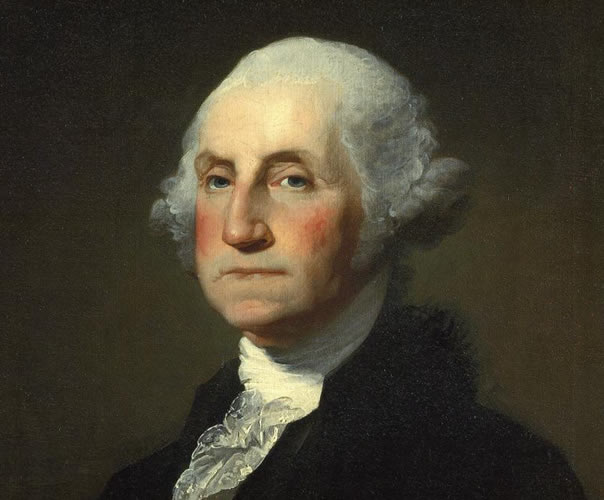
George Washington was born on February 22, 1732 in Westmoreland County, Virginia, although he grew up near Fredericksburg. In his childhood and adolescence, he studied math and surveying. When he was 16, he went to live with his brother Lawrence in Mount Vernon. George was scarred with Smallpox before the age of 20, but inherited his brother's land (including Mt. Vernon) when he died in 1752.
Learn more about Mt. Vernon
French and Indian War
Washington's military career began in 1753, when he was sent into Ohio country during the French and Indian War to protect British interests in the area. In 1754, he battled the French and was forced to surrender Fort Necessity (near present-day Pittsburgh, Pennsylvania). He continued as an officer in Ohio country, and served under the British general Edward Braddock when their army was ambushed by the French in 1755. Once again, Washington tasted defeat after their surrender of Fort Duquesne to French forces. Luckily for the future United States, the French agreed to release him rather than keep him as a prisoner. He helped take Fort Duquesne back in 1758.
Commander of Continental Army
Washington was married to Martha Custis in 1759. He managed the family and estate until he took command of Virginia troops just before the American Revolution. He was made commander of the Continental Army on June 15, 1775. Washington, however, would struggle with a rag-tag army of volunteers and militia men. His armies were constantly low on supplies and food, and often times marched to battle without shoes. They were routed in a series of battles in and around New York City in 1776 and forced to retreat into Pennsylvania where he planned a strategic ambush. On Christmas night 1776, Washington and his men crossed the Delaware River and captured a band of 800-900 Hessian soldiers. Hessians were fearsome German mercenaries hired by the British as soldiers. The event came to be known as "Washington's Crossing" and was successful in raising the morale of the entire army. The dramatic ambush would be called The Battle of Trenton. Throughout the war, Washington campaigned the Continental Congress tirelessly for food, supplies, and clothing for his soldiers, and managed to keep the Continental Army together in spite of dire circumstances and incredible odds against him.
Learn more about the Continental Army | The Battles of New York | The Battle of Trenton | Battle of Princeton

Washington's Crossing - Leutze |
Yorktown
Washington proved himself an excellent leader, and won several other decisive battles during the Revolution. In 1781, he helped to formulate the plan that eventually resulted in the defeat of the British army at Yorktown, Virginia and the British surrender.
Learn more about Yorktown
First President
As an advocate of a federal government, Washington became chairman of the Constitutional Convention and helped in getting the Constitution ratified. In 1789, he was inaugurated as America's first president after refusing to be coronated as king. Washington was re-elected for a second term in 1792, but refused a third term.
Histography and Scavenger Hunt
Death and Legacy
On December 14, 1799, seventeen days before the new century, Washington died of acute laryngitis or epiglottitis. Today, George Washington is probably the most honored individual in American history. Numerous cities, towns, highways, monuments, and parks bear his name. The capital of the United States is named after him. He was honored on the first American postage stamp, as well as on the quarter and one dollar bill. He even has a state named after him - Washington, although he never set foot there.
Discussion Questions
- Why was Washington’s leadership during the Revolutionary War so important to American independence?
- How did Washington’s experiences in the French and Indian War shape his future leadership?
- Why did Washington refuse to become king, and what impact did that decision have on American democracy?
- In what ways does Washington’s legacy continue to influence the United States today?
Glossary
- Smallpox: A contagious, deadly disease eradicated in the 20th century, which left scars on survivors.
- Hessian: German mercenaries hired by the British during the American Revolution.
- Constitutional Convention: The 1787 meeting where U.S. leaders drafted the Constitution.
- Yorktown: Site of the decisive American victory over British forces in 1781.
Five Interesting Facts
- George Washington never had children of his own.
- He was the only U.S. president unanimously elected—twice.
- Washington’s teeth were not wooden; they were made of ivory and other materials.
- He refused payment for his military service during the Revolution.
- The state of Washington was named in his honor, though he never visited it.
Timeline of George Washington’s Life
- 1732: Born in Westmoreland County, Virginia.
- 1748: Worked as a land surveyor at age 16.
- 1752: Inherited Mount Vernon after Lawrence’s death.
- 1753: Began military career in French and Indian War.
- 1754: Surrendered Fort Necessity.
- 1755: Served under General Braddock; British defeated.
- 1758: Helped capture Fort Duquesne.
- 1759: Married Martha Custis.
- 1775: Became Commander-in-Chief of Continental Army.
- 1776: Crossed the Delaware and won Battle of Trenton.
- 1781: Victory at Yorktown ended the war.
- 1787: Presided over Constitutional Convention.
- 1789: Inaugurated as first U.S. President.
- 1797: Retired after two terms.
- 1799: Died at Mount Vernon.
|