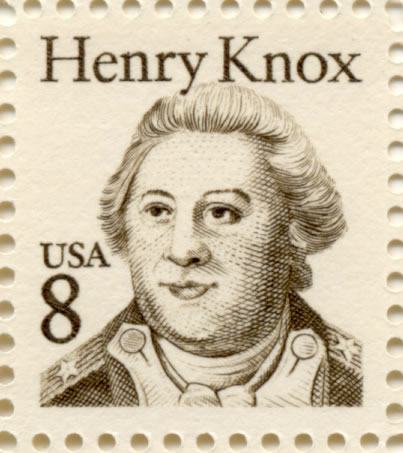
Henry Knox |
Knox Joins the Continental ArmyIn 1772, Henry Knox joined the Boston Grenadier Corps where he gained more experience with military artillery. In 1775, Knox voluntarily fought at the Battle of Bunker Hill and served under General Ward. In 1775, Knox would also meet General George Washington. General Washington had taken over command of the Continental Army. Henry Knox and Washington soon became friends because of their shared interest and knowledge of military history and artillery. General Washington decided to make Henry Knox a colonel in command of the Continental Army's artillery division. The Noble Train of ArtilleryAfter being placed in command of the artillery, Colonel Knox was charged with moving approximately 50 cannons to Boston from then seized Fort Ticonderoga in what would come to be known as the noble train of artillery. Colonel Henry Knox was able to successfully move the captured cannons more than 300 miles through the Berkshire Mountains by ox sled to Boston in just over six weeks. The cannons, which were strategically placed on Dorchester Heights overlooking Boston, prompted British naval forces occupying Boston Harbor to evacuate. Knox's amazing feat is commemorated as part of the Henry Knox Trail in New York and Massachusetts. Learn more about: Fort Ticonderoga | the Noble Train of Artillery LegacyColonel Henry Knox continued to advise General Washington and command a military division of artillery throughout the Revolutionary War. Colonel Knox's knowledge and expertise in military artillery helped General George Washington and America gain its independence from England. Henry Knox died at the age of 56 in 1806 in Thomaston, Maine. In 1772, Henry Knox joined the Boston Grenadier Corps and learned about military weapons. In 1775, he fought at the Battle of Bunker Hill and met General George Washington, who had just taken command of the Continental Army. The two became friends, and Washington made Knox the leader of the army's artillery division. The Noble Train of ArtilleryAs head of artillery, Knox was given the job of moving about 50 cannons from Fort Ticonderoga to Boston. He moved them over 300 miles through snowy mountains using ox sleds, and it took just over six weeks. Once in Boston, the cannons were placed on high ground and forced the British to leave the city. This event is remembered today as part of the Henry Knox Trail. LegacyHenry Knox continued to help General Washington and led the artillery during the war. His skills helped America win independence from Britain. He died in 1806 at the age of 56 in Thomaston, Maine. |
| Henry Knox Activities |
|