Constitution-era Historic Events |
|
| Click on an event below for a detailed article and printable and online activities. | |
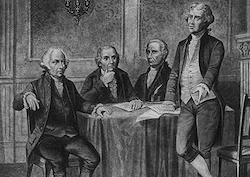 |
The Articles of Confederation were the first constitution of the United States, created during the Revolutionary War to unite the thirteen colonies under a weak central government. Although it helped guide the nation through war, it lacked key powers like taxation and enforcement, leading to its eventual replacement by the U.S. Constitution in 1787. |
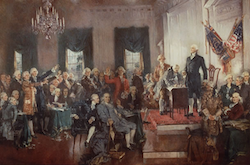 |
Constitutional Convention and Great Compromise The Constitutional Convention was held in Philadelphia in 1787 to address the weaknesses of the Articles of Confederation. Delegates from twelve states ultimately created a new U.S. Constitution, establishing a stronger federal government with three branches. |
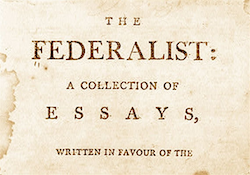 |
The Federalist Papers were a series of 85 essays written by Alexander Hamilton, James Madison, and John Jay to support the ratification of the U.S. Constitution. These essays explained the benefits of a strong central government, ultimately helping to persuade states to approve it. |
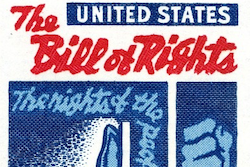 |
Bill of Rights
The 1791 Bill of Rights is the first ten amendments to the United States Constitution, guaranteeing fundamental freedoms such as speech, religion, and the right to a fair trial. It was created to protect individual liberties and limit the power of the federal government. |
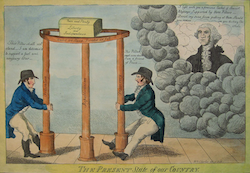 |
Federalists, led by Alexander Hamilton, supported a strong central government, a national bank, and close ties with Great Britain. In contrast, Jeffersonian Republicans, led by Thomas Jefferson, advocated for a limited federal government, a focus on agriculture, and greater independence from Britain. |