Famous Americans Writing Prompts and Printable Activities
|
||||
| Revolutionary War Era | ||||
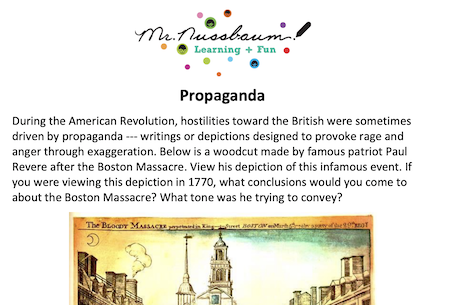
| Propaganda and the Boston Massacre (Paul Revere) - This activity requires students to examine the famous Paul Revere hyperbolic engraving depicting the Boston Massacre before the Revolutionary War. How was Paul Revere’s depiction of the Boston Massacre different from what really happened?
|
||||
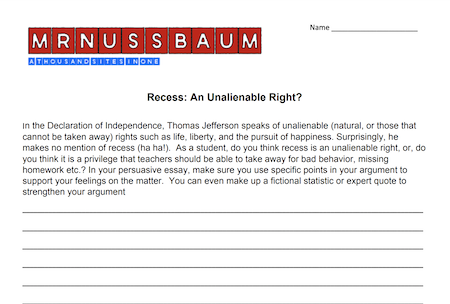
| Is Recess an Unalienable Right? (Thomas Jefferson) This writing prompt requires students to understand the concept of unalienable rights and then to form a persuasive essay on whether recess is a right or privilege that teachers should be able to take away.
|
||||
| The Redemption of Benedict Arnold- This prompt requires students to examine the life of Benedict Arnold and to write a letter than attempts to redeem him in American history. The prompt ENCOURAGES students to use hyperbole, perspective, and to downplay facts not favorable to Arnold in this argument. |
||||
The Art of the Deal ( Hamilton, Jefferson, Madison) - The Compromise and the Art of the Deal prompt explores how Alexander Hamilton, Thomas Jefferson, and James Madison made a secret agreement in 1790 that shaped the nation’s future — trading Hamilton’s financial plan for the new capital’s southern location along the Potomac. It invites students to connect this historic political bargain to their own experiences with negotiation, compromise, and finding common ground. |
||||
| And Justice for ALL (John Adams)- The Justice for All prompt highlights how John Adams risked his reputation to defend the British soldiers accused in the Boston Massacre, standing up for fairness even when the public demanded revenge. It encourages students to reflect on the courage it takes to protect justice and truth, even when doing so is unpopular.
|
||||
| Frenemies (Adams, Jefferson) - John Adams and Thomas Jefferson - The Frenemies prompt explores the complicated relationship between John Adams and Thomas Jefferson — two friends turned rivals who eventually rediscovered mutual respect through years of heartfelt letters. It invites students to consider how conflict, forgiveness, and understanding can strengthen relationships and help people grow.
|
||||
| Justice or Mercy? (George Washington) - The Justice or Mercy prompt examines George Washington’s difficult decision to execute British officer Major John André after Benedict Arnold’s betrayal, balancing compassion against the need for fairness and discipline. It challenges students to think about when it is better to show mercy and when justice must take priority.
|
||||
| Sacrifice (George Washington) - The Sacrifice for a Greater Cause prompt tells the story of Nathan Hale, a young patriot who gave his life while spying for the Continental Army and declared he had only one life to lose for his country. It encourages students to reflect on what it means to give up something important for a belief, a goal, or the good of others.
|
||||
| Hope (George Washington) - The Hope in Times of Uncertainty prompt focuses on George Washington’s determination during the darkest days of the Revolution, when defeat seemed certain after losses in New York. It inspires students to think about how hope and faith can help people persevere through impossible circumstances.
|
||||
| Impossible Circumstances (George Washington) - The Perseverance and Endurance prompt centers on George Washington’s leadership during the brutal winter at Valley Forge, where hunger, cold, and doubt tested every soldier’s spirit. It encourages students to consider how true strength often means enduring hardship and continuing forward when giving up would be easier.
|
||||
A Signature to Remember (John Hancock) This American Revolution/Revolutionary War activity tells the story of the iconic John Hancock signature on the Declaration of Independence and then challenges students to come up with their own, creative signature. |
||||
| The Summer Soldier and Sunshine Patriot - Figurative and Literal Meaning in Thomas Paine's The Crisis - This activity challenges students to explore the figurative vs literal language from Thomas Paine's The Crisis and to ultimately illustrate two versions of the "summer soldier" and "sunshine patriot." |
||||
| Ben Franklin's Quarter - This activity explains Franklin's preference for the wild turkey as America's national symbol and requires students to redesign the back of the quarter according to Franklin's wishes. Great Thanksgiving exercise!
|
||||
| The Last Conversation Between Benjamin and William Franklin - This activity requires students to pen dialogues between William (Ben's loyalist son and royal governor of New Jersey) and Benjamin (a Patriot). Students should demonstrate their knowledge of Loyalist and Patriot sentiments through the dialogue.
|
||||
| The Franklin Shield - This fun social studies activity requires students to create a Franklin family shield based on the many accomplishments of Benjamin.
|
||||
| Settling the Score (Hamilton, Burr) - This prompt requires students to help Alexander Hamilton and Aaron Burr find a more productive way to settle their differences instead of staging a duel.
|
||||
| Revolutionary War Figures and Social Media - This fun activity challenges students to create a static social media page about their favorite revolutionary figure.
|
||||
| Lewis and Clark | ||||
| Unsung Hero (Sacagawea) - This activity explains the idea of Sacagawea as an unsung hero. Students must then write about an unsung hero they select from movies, literature, sports, or their own lives. | ||||
| Dynamic Duos (Lewis and Clark) - This printable exercise requires students to compare Lewis and Clark to other "dynamic duos" in literature, movies, or even sports. | ||||
| The Climb (Lewis and Clark) - This printout requires students to consider a time when they thought they were at the cusp of finishing something great, only to learn there was MUCH more work to do. | ||||
| Civil War Era | ||||
| Henry Clay - The Peacemaker- This prompt describes the role Henry Clay played in brokering the Missouri Compromise and the Compromise of 1850 and then asks students to write about a time that they've played "peacemaker." |
||||
| An Eye for an Eye (John Brown) - This activity requires students to consider the actions of John Brown at Pottawatomie and write about the idea of "an eye for an eye."
|
||||
John Brown: Iconic Image Analysis - This activity requires students to analyze the symbolism and meaning of the iconic painting Tragic Prelude, which protrays John Brown as a madman. |
||||
| Counting Chickens Before They Hatch - A Lesson From Shiloh (P.G.T Beauregard) - This writing prompt requires students to relate to P.G.T. Beauregard’s "complete victory" telegraph at Shiloh by writing about a time they "counted" chickens, or, examples from literature of movies.
|
||||
| The Great Squander (George McClellan) - This historical prompt challenges students to consider the great opportunities squandered by Union General George McClellan prior to Antietam. Then, to think of and write about a time when they may have squandered a "golden" opportunity.
|
||||
| Lee's Greatest Victory - Chancellorsville (Robert E. Lee) - This activity requires students to relate to Lee's "Greatest Victory" at Chancellorsville, by describing their greatest moment at sports, music, dance, or even video games.
|
||||
| Difficult Choices - Lee's Dilemms (Robert E. Lee) - This handout requires users to think about the difficult decision that faced Robert E. Lee at the onset of the Civil War – take the command of the Union Army, or, fight for the Confederacy? Students then must relate a similar experience where he or she had to choose one side or the other and the associated opportunity cost.
|
||||
| Forgiveness - The Disaster that was Pickett's Charge (Lee, Pickett) - Following the ill-fated infantry charge known as Pickett's Charge, on the last day of Gettysburg, Confederate Major General George Pickett was said to have harbored a life-long bitterness toward Robert E. Lee, who ordered the charge. This writing prompt requires students to think about the concept of forgiveness and describe the process he or she goes through when deciding whether or not to forgive someone.
|
||||
| Hindsight is 20/20 - The Aftermath of Pickett's Charge (Pickett, Longstreet) - This writing activity explores the meaning of the metaphor "hindsight is 20/20"—the idea that it's easy to see the best course of action after a situation has already happened. Students will examine how this metaphor applies to General James Longstreet's warning before Pickett’s Charge at the Battle of Gettysburg and how it was ignored, resulting in disastrous consequences.Students will then reflect on a time when they or someone else experienced a similar moment—when a decision seemed right at the time but turned out to be a mistake in hindsight. They may choose to write about a situation in literature, movies, or real-life.
|
||||
| The One - The Union Army Finally Finds Their Guy (Ulysses S. Grant) - The United States finally found "the one" nearly three years after the first shots of the Civil War were fired at Fort Sumter. Finally, it had a military leader capable of guiding the massive Army of the Potomac to victory. "The one" was Ulysses S. Grant. There were many reasons why he could be considered "the one." This essay requires students to discover and elaborate on those reasons.
|
||||
| Primary Source Analysis: Magnanimity (Ulysses S. Grant) - The Generous Terms of Surrender at Appomattox - This printable activity requires students to analyze the actual conversation between Lee and Grant that led to the surrender of the Army of Northern Virginia and to describe a similar display of magnanimity and grace in their own lives, or in literature or movies.
|
||||
| Two Last Names (Jefferson Davis) - When his parents named him after Thomas Jefferson, the third president of the United States, Jefferson Davis became one of those people whose name was made up of two last names.Now imagine you’ve been given the chance to change your name for one day. The only rule is that your new name must be made up of two last names—the last names of two people you greatly admire.
|
||||
| Peccadillos (Stonewall Jackson) - This writing activity requires students to read about the many peccadillos of Stonewall Jackson before analyzing and writing about one of their own, or one of an anonymous friend or character in literature, movies, or sports.
|
||||
What did the Nickname Stonewall Really Mean? (Stonewall Jackson) -This fun activity requires students to analyze how emphasis can change the meaning of identical sentences, and describe what Bernard Bee may have meant by uttering the famous words "there is Jackson standing like a stone wall." Was he inspired or angry? See how emphasis changes the meaning of his words. |
||||
The Famous Last Words of Stonewall Jackson at Chancellorsville - This activity describes Stonewall Jackson's famous last words after being shot at the Battle of Chancellorsville and challenges students to pen their own final words, or, those of a character in movies or literature. |
||||
| The Power of Dreams: Abraham Lincoln's Tragic Prophecy - This printout describes Abraham Lincoln’s famous dream about his own assassination and then requires students to describe and draw a scene from a powerful dream they’ve had.
|
||||
Oh Captain! My Captain! An Elegy to Abraham Lincoln - The printout describes Walt Whitman’s famous Oh Captain! My Captain! elegy to President Lincoln and then asks students to think of their own hero and to write a similar poem. |
||||
| Misunderstood - The Unfair Legacy of Mary Todd Lincoln - Many historians believe that Mary Todd Lincoln was deeply misunderstood. This activity explores what it means to be misunderstood and why Mary Todd Lincoln may have been viewed unfairly by others during her life. After learning about her experiences, think about another person—real or fictional—who you believe was misunderstood. This could be a character from real life, a movie, a book, sports, or even a video game. Write about who they are, why they were misunderstood, and how their story makes you think differently about judging others too quickly.
|
||||
| Kate Chase - The Original Influencer 150 Years Before YouTube and Insta - This activity requires students to compare and contrast Kate Chase, a prominent Washington socialite, with modern-day influencers.
|
||||
Harriet Tubman - Imagery and Inspirational Portrait - This activity requires students to choose from four different Harriet Tubman quotes and to design an inspiration portrait (such as those in office buildings) based on the quote. Great for hanging up in the hallways or classroom bulletin boards. |
||||
| The Abolitionist Hall-of-Fame - Harriet Beecher Stowe and Frederick Douglass - Pretend you have been chosen to induct Frederick Douglass and Harriet Beecher Stowe into the fictional abolitionist hall-of-fame. Your first job, however, is to design a “flyer” that advertises the inductees and the reasons for their inductions. In the spaces provided continue the narratives that highlight each inductee’s accomplishments. Secondly, design an abolitionist hall-of-fame medal each would receive upon their entry. Medals can include icons, symbols, color, and their names.
|
||||
Virtual History Teacher - Studies in Elaboration - These fun activities requires students to role play as history teachers grading student tests that reflect poor efforts. "Teachers" must grade the tests and then elaborate on student answers to make them complete answers. Boston Massacre | Boston Tea Party | Thomas Jefferson | Crispus Attucks | George Washington |