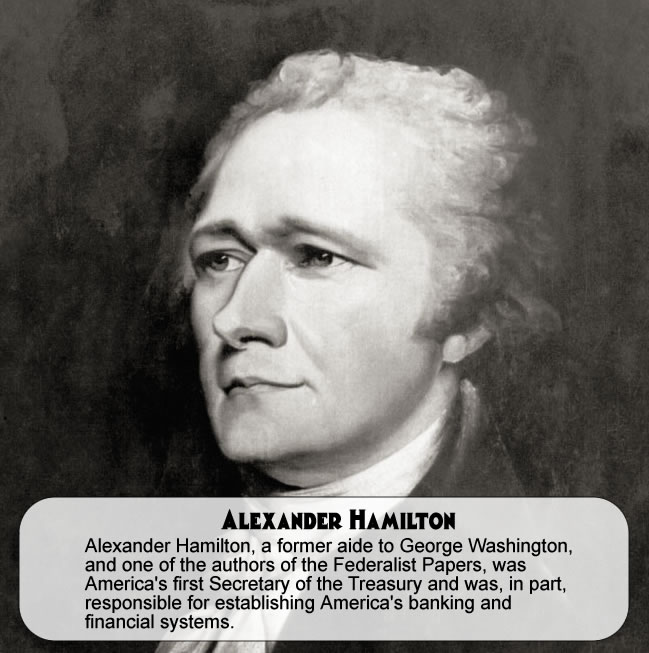
Alexander Hamilton |
||
Humble BeginningsAlexander Hamilton was born January 11, 1755, on the Caribbean island of Nevis. His father abandoned him and his mother died when he was just a boy. Despite the hardships he experienced, his shrewd and ambitions mind carried him far. At age 12, Hamilton served as an apprentice at the Counting House of Nicholas Cruger and David Beekman. At age 15, Hamilton was put in charge of the business.Off to CollegeDespite a lack of formal schooling during his adolescent years, Hamilton was an intelligent boy and knew both English and French. He was an excellent writer and was published for his descriptive account of a hurricane that ravaged the Caribbean islands. Friends of his family were impressed by his writing and paid for his formal schooling. Hamilton soon entered King’s College in New York City and earned a bachelor’s degree in 1774—in one year!Strong Political FeelingsHamilton gained political prominence later that year when he traveled to Boston to show his support for the colonies. While in Boston, he delivered a powerful speech denouncing British policies and wrote two pamphlets attacking a clergyman’s opposition to the Continental Congress. Fighting in the Revolutionary WarDuring the American Revolution, Hamilton was commissioned as the captain of a company of artillery that defended Patriot interests at Long Island and White Plains. Hamilton’s military tactics won widespread praise and earned him a reputation for decisiveness and bravery. He was soon introduced to General George Washington who appointed him to his personal staff with the rank of lieutenant colonel. He became Washington’s personal secretary and gathered pivotal intelligence at the Battle of Monmouth in 1778. At Monmouth, Hamilton’s leadership and spirit helped rally retreating troops who promptly routed the British. The ambitious Hamilton later served at the Battle of Yorktown where he led a Patriot assault against the British. Learn more about the Battles of: New York | Monmouth Courthouse | Yorktown Rising to ProminenceAlexander Hamilton married Elizabeth Schuyler in 1780 and eventually had eight children. In 1783, Hamilton was admitted to the New York State Bar after studying for three years. He soon opened his own law practice on Wall Street in New York City. He also served in Congress from 1782 to 1783, was elected to the Continental Congress, and founded the Bank of New York in February of 1784. One of America's Founding FathersAlthough Hamilton supported a Parliamentary-type government, he is most famous for his works regarding the US Constitution and the Federalist Papers. He was a staunch supporter of the Constitution and helped in its creation and execution. He was also the primary author of the Federalist Papers, a classic commentary on principles of government and American constitutional law. When George Washington was elected president, Alexander Hamilton was appointed the United States’ first Secretary of the Treasury. Hamilton is credited with the establishment of America’s financial system and took great care in establishing America’s credit at home and abroad. His opinions concerning the structure and function of the national bank were groundbreaking and are still the inspiration behind the English and German economic systems. Hamilton also established an American philosophy on foreign policy and influenced George Washington to assert a position of neutrality regarding the French Revolution. Learn more about: The Federalist Papers | George Washington The Decline of the FederalistsHamilton resigned from the treasury in 1795 but remained one of Washington’s most trusted advisors. After returning to his New York law practice and serving in the military for two more years, Hamilton’s Federalist Party became divided. Hamilton disagreed with many of the policies implemented by president John Adams and sought to control his policy as well as members of his cabinet. He wrote a seething letter denouncing Adams that was intended for private circulation. Vice President Aaron Burr, however, published the letter which was distributed to the public. Burr’s actions stirred great anger in Hamilton, who promptly short-circuited Burr’s political aspirations for president and governor. In the presidential election of 1800, in which Burr was campaigning, Hamilton persuaded the House of Representatives that Burr was untrustworthy and urged them to vote for Thomas Jefferson. He did the same when Burr lost the election for governor of New York. Learn more about: the Federalists | John Adams
Alexander Hamilton 200th Birthday Postage Stamp Duel with Aaron BurrAaron Burr had finally had enough with Hamilton after this failure in New York. Burr challenged him to a duel on July 11, 1804. Burr won the duel and Hamilton died the next day from his wounds. LegacyAlexander Hamilton will always be remembered as one of America’s greatest economic and political minds.His ideas still influence politics and economic policy today. He is immortalized on the United States ten-dollar bill. Alexander Hamilton was born on January 11, 1755, on the Caribbean island of Nevis. His father left the family, and his mother died when he was young. Despite this, Hamilton was smart and determined. By age 12, he worked at a trading company and was running it by age 15. Off to CollegeHamilton didn’t have much formal schooling, but he was very intelligent and knew both English and French. He wrote a powerful letter about a hurricane, and people were so impressed they paid for him to study in New York. He attended King’s College (now Columbia University) and earned a degree in just one year. Strong Political FeelingsHamilton became known for his political ideas. He gave speeches and wrote pamphlets supporting the colonies and criticizing British rule. He believed strongly in American independence. Fighting in the Revolutionary WarHamilton became a captain in the American army and fought in battles at Long Island and White Plains. He was brave and smart, and George Washington made him his assistant and a lieutenant colonel. At the Battle of Monmouth, Hamilton helped turn the fight around. He also played a key role in the final battle at Yorktown. Rising to ProminenceIn 1780, Hamilton married Elizabeth Schuyler and had eight children. He became a lawyer in New York and served in Congress. He helped start the Bank of New York in 1784. One of America's Founding FathersHamilton supported a strong national government. He helped write the U.S. Constitution and was the main author of the Federalist Papers, which explained how the new government should work. As the first Secretary of the Treasury, he created America’s financial system and helped the country earn respect from other nations. The Decline of the FederalistsHamilton left his government job in 1795 but stayed active in politics. He disagreed with President John Adams and wrote a letter criticizing him. Vice President Aaron Burr shared the letter publicly, which upset Hamilton. Hamilton later worked to block Burr’s political career by supporting Thomas Jefferson in the 1800 election. Duel with Aaron BurrIn 1804, Burr challenged Hamilton to a duel after losing the election for governor of New York. The duel took place on July 11, and Burr shot Hamilton. Hamilton died the next day. LegacyAlexander Hamilton is remembered as one of America’s most important founders. His ideas about government and the economy still influence the country today. He is honored on the ten-dollar bill. |
||
| Alexander Hamilton Activities | ||
|
||
|