 |
History of Nevada
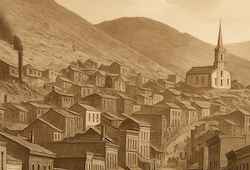
Nevada became the 36th state in 1864 during the Civil War, known as the "Battle Born" state because it joined the Union at that time. Its history was shaped by the discovery of the Comstock Lode, one of the richest silver deposits in the world, which brought rapid growth and settlement. |
|
 |
Paiute Nation
The Paiute Nation is made up of Native American tribes that traditionally lived across Nevada, Utah, California, and Arizona. They are known for their deep connection to the desert landscape, skilled basket weaving, and strong preservation of their language and culture. |
|
 |
Shoshone Nation
The Shoshone Nation, originally spread across the western United States, lived in areas of present-day Wyoming, Idaho, Utah, and Nevada. They were skilled hunters, gatherers, and horsemen, with distinct groups such as the Eastern, Northern, and Western Shoshone.
|
|
 |
The Travels of John C. Frémont
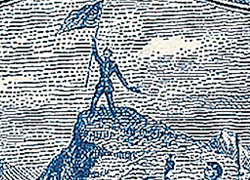
John C. Frémont played a key role in Manifest Destiny by leading multiple expeditions that mapped and explored the American West, providing vital information for settlers and expansion. His reports and maps encouraged migration to California and Oregon, and he later helped secure California for the United States during the Mexican-American War.
|
|
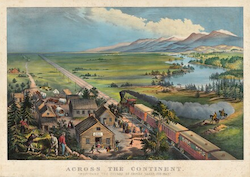 |
Manifest Destiny
Manifest Destiny was the 19th-century belief that the United States was destined by God to expand its territory across North America. It was used to justify westward expansion, the displacement of Native Americans, and wars such as the Mexican-American War. |
|
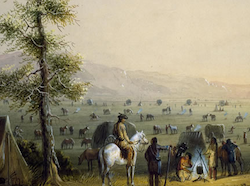 |
California Trail
The California Trail was a major overland route used by pioneers in the mid-1800s to reach California during the Gold Rush. Stretching over 2,000 miles, it followed parts of the Oregon Trail before branching off toward the Sierra Nevada. |
|
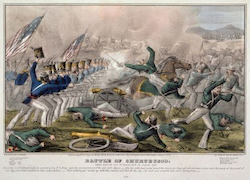 |
Mexican-American War and the Acquisition of the West
The Mexican-American War (1846–1848) was a conflict between the United States and Mexico following the U.S. annexation of Texas and disputes over the southern border. It ended with the Treaty of Guadalupe Hidalgo, through which the U.S. gained a large portion of the Southwest and established the Rio Grande as the border with Mexico.
|
|
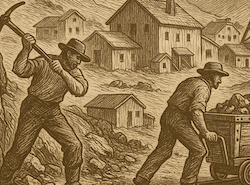 |
Comstock Lode and the Nevada Silver Rush
The Comstock Lode, discovered in Nevada in 1859, was the first major silver ore deposit found in the United States. It sparked a mining boom that brought thousands of settlers to the area and helped fund the Union during the Civil War. |
|
 |
Compromise of 1850
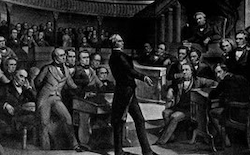
The Compromise of 1850 temporarily eased tensions between free and slave states by balancing interests, but its enforcement of a stricter Fugitive Slave Law angered many in the North. While it delayed secession, the compromise deepened sectional divides and set the stage for future conflicts, making civil war more likely. |
|