Virginia Colony |
||||||||
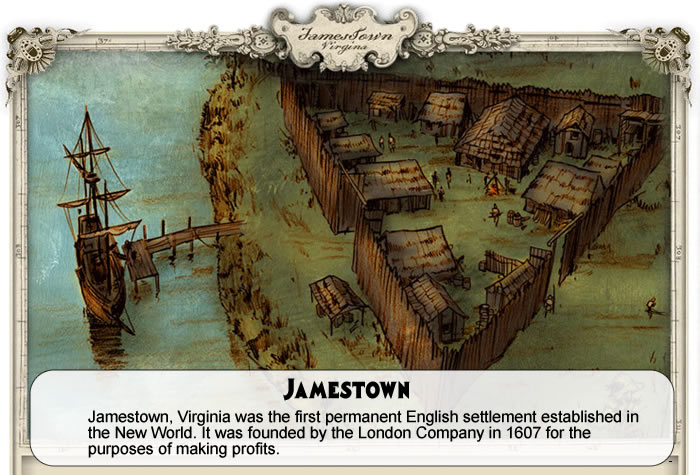
First Permanent English SettlementDespite the failure of the Lost Colony at Roanoke, King James I was eager to start a permanent English settlement in North America. He granted charters to a pair of English companies to establish those settlements. While one of the two companies was unsuccessful in establishing a colony in present-day Maine, the other, known as the London Company, led by captain Christopher Newport, sailed to Virginia and established a settlement on a swampy peninsula on the James River. Click here to learn more about Christopher Newport Unfit for Life in the WildernessWhile the chosen location certainly provided good cover from the potential ambushes of local Indians, its swampy climate led to horrible diseases such as Dysentery and Malaria. Jamestown further suffered from poor and corrupt leadership and a population of men that were unfit for life in the wilderness. Many were there for the opportunity to make a lot of money and refused to participate in building shelters or collecting food. Settlers constantly bickered with each other and found relatively little in the way of natural resources or wonders to send back to England. John Smith's PowerBecause Jamestown was built on traditional hunting grounds of the Algonkin Indians, trouble arose soon after their arrival. By the winter of 1607, only 38 out of the original 104 settlers were still alive. Food shortages were making unbearable situations even worse. Jamestown was on the brink of collapse until JOHN SMITH formulated plans to procure Indian corn and other foods via trade. Smith's first excursions were extremely successful, and he returned to the beleaguered colony with large quantities of corn and beans. On one of his excursions, however, he was ambushed by Indians and taken to the great king Powhatan. Smith used his charm and persuasion to convince Powhatan that the settlers were peaceful and did not intend to build a permanent settlement at Jamestown. Smith was subsequently returned to Jamestown and gained influence among the colonists.
Smith Becomes President of the Jamestown CouncilIn winter of 1608, Jamestown remained a desperate settlement with serious leadership problems and a food shortage. John Smith became hated by much of the so-called leadership. Despite at least one attempt on his life, Smith was named president of the Jamestown Council because of his previous experience and because he was one of the few colonists who knew what it took to survive at Jamestown. The Life-Force of JamestownFor the next year, Smith managed the colony about as well as it could be managed. He forced all colonists to work and contribute to the colony as a whole. He imposed badly-needed discipline and even staged shooting contests and drills to scare local Indians who were surely spying on them. Besides managing Jamestown, John Smith procured food from local Indians for European trinkets and goods. Despite Powhatan's demand for guns, John Smith refused to trade them, and often burned villages and stole food when Indians would not trade. Smith's power terrified the Indians, who came to think of him as virtually indestructible. Powhatan rightfully saw him as the life-force of Jamestown and sent his warriors on countless missions to kill him. While John Smith escaped death many times with firepower, Powhatan's daughter, the princess Pocahontas, took a special liking to him, and informed him in advance when her father would send warriors after him. Click here to learn more about John Smith | Click here to learn more about Pocahontas
Smith Returns to EnglandThe Jamestown colony flourished under the strict rule of John Smith. Nevertheless, The London Company (which was now called the Virginia Company) had formed a new government that was to be led by Thomas De La Warre. The new charter issued by the Virginia Company called for the appointment of a governor rather than a president. John Smith, who nearly died after igniting himself in a canoe, returned to England for good. Since De La Warre was unable to make the trip immediately, Thomas Gates was named interim governor. Unfortunately, Gates' ship wrecked off the coast of Bermuda and he was unable to resume the trip until new ships were built. A New Outlook on ProfitMeanwhile, the Virginia Company was in the process of reformulating its philosophy on potential profits in Jamestown. By 1609, it became obvious that profits would have to be realized over a long-term basis rather than immediately. The Virginia Company began reorganizing business possibilities to resemble those that had been successful in controlling the populations in Ireland. They proposed to bring England to the New World by sending families to Jamestown. Families were promised their own parcels of land for seven years of communal labor at Jamestown. This, the Virginia Company believed, would cause colonists to have a permanent stake in the welfare of the community as a whole, which would result in increased productivity and profit. Those that were not wealthy enough to pay their passage to the New World would have their trip subsidized (paid for) in exchange for seven years of labor. Those individuals became servants. The Starving TimeWith John Smith out of the picture, and with the lack of a visible leader at Jamestown (because of Gates' shipwreck), Powhatan saw an opportunity to rid himself of the white settlers once and for all. Hence, Powhatan ordered his people to stop trading with the settlers. Without any leadership, and more specifically without the leadership of John Smith, the settlers once again became complacent and stopped contributing to the welfare of Jamestown. Trading teams that departed from Jamestown to Powhatan's lands rarely returned and were presumed dead. Without corn from the Algonkins, with settlers who refused to work, and with Powhatan's warriors seemingly closing in around them, the winter of 1609-1610 became known as the "Starving Time". Colonists were forced to eat cats and dogs and some were even executed for digging up human corpses to eat. When Gates finally arrived in 1610, only about 60 of the 500 settlers were still alive. Gates decided to abandon the settlement and nearly set sail with the remaining settlers for England. While Powhatan and his people celebrated wildly, Thomas De La Warre arrived with three fully supplied ships with a mission to stay indefinitely. Click here to learn more about the Starving Time | Click here to learn more about the Powhatan People The Return of DisciplineIDe La Warre and Gates re-established the tough discipline that had led the colony to success under John Smith. Under the set of rules developed by Gates and enforced by Sir Thomas Dale (the future governor of Virginia), settlers would be brutally punished for breaking the rules. Settlers were shot, burned at the stake, and hung at the gallows. Such transgressions as cursing carried physical torture or public humiliation as consequences. Increasing ViolenceDuring this time relations with the Indians worsened. The settlers were still dependent on the Indians for food, and became more and more violent in their quests to obtain it. The Indians, in turn, responded in kind, resulting in a bloody series of killings on both sides.The Kidnapping of PocahontasDuring the winter of 1612-1613, Samuel Argall devised a plan to kidnap Powhatan's favorite daughter, Pocahontas, who was visiting friends near Jamestown. Argall bribed two Indians with somecopper kettles to lure Pocahontas onto an English ship. Although Pocahontas was suspicious, she boarded the ship and was kidnapped. Argall planned to ransom Pocahontas, but Powhatan was unwilling to meet the demands of the English. Negotiations dragged on for over a year, during which time, Pocahontas grew accustomed to life among the English. In captivity, she converted to Christianity, was baptized, and in 1614, married the wealthy tobacco planter John Rolfe. The marriage of Rolfe and Pocahontas resulted in a truce between the Indians and the English. Although Powhatan was unhappy with the marriage and truce, as he realized in would result in the expansion of the English settlement, he grew tired of the fighting and felt powerless to stop it. Click here to learn more about John Rolfe | Learn more about the kidnapping of Pocahontas Jamestown's Cash Crop and the Headright SystemDespite the truce, Jamestown remained a dismal place for most of the settlers. Food shortages and disease were rampant in Jamestown. Because Rolfe's tobacco crop showed such promise for profit, many settlers began growing their own, though few reserved space for corn. Tobacco became the cash crop of the Jamestown settlement. In 1614, conditions improved for settlers when Thomas Dale, using his powers as governor, began transferring some of the land to private ownership. In order to continue growing tobacco, the Virginia Company needed a substantial workforce. Through "the Headright System", English settlers were guaranteed 50 acres of land in return for three years of labor. "Heads of Families" who came to the New World were guaranteed 50 acres of land for each person they brought over. With their own lands, settlers began to build houses, tend to their land and grow crops which resulted in a new hope and inspiration for a successful colony. Click here to learn more about Tobacco in the Southern Colonies | Click here to learn more about the Headright System The Last MassacresUnfortunately, Jamestown's future was not bright. Powhatan's successor, Opechancanough, attacked the white settlements near Jamestown in order to prevent the settlers from taking more land for tobacco. It was a surprise attack, as the warriors approached the settlements as if they were preparing to trade. The attacks decimated the settlements and resulted in the deaths of 347 settlers, including John Rolfe. The attacks were especially surprising considering the peaceful relations that had reigned for many years. Although the Indians were driven back and eventually completely defeated, In 1624, as a result of the high mortality rates at Jamestown, and the colony's poor financial state, King James revoked the colony's charter and made Virginia a possession of the crown. Discussion Questions
Glossary
First Permanent English SettlementIn 1607, the English started Jamestown in Virginia, the first permanent English colony. The London Company funded the trip, and Captain Christopher Newport led the settlers to a swampy area along the James River. Tough ConditionsThe swampy land brought disease like malaria, and many settlers refused to work. Food was low, and leadership was weak. Only 38 of the first 104 settlers survived the first winter. John Smith's LeadershipCaptain John Smith traded for food with the Powhatan Indians. He demanded all settlers work and helped keep the colony alive. Some stories say Powhatan's daughter Pocahontas helped save his life. The Starving TimeWhen John Smith left after an injury, things got worse. Powhatan stopped trading food, and settlers began to starve. In the winter of 1609-1610, they ate animals—and even dug up graves. Only 60 of 500 settlers survived. Help ArrivesJust as the settlers were ready to leave, new ships arrived with supplies and a new leader, Lord De La Warr. He brought strict rules to help restore order. Pocahontas and PeaceIn 1613, Pocahontas was kidnapped by the English. She learned English, became a Christian, and married John Rolfe. This marriage helped bring peace between settlers and the Powhatan for a time. Tobacco and GrowthJohn Rolfe started growing tobacco, which made Jamestown profitable. The "Headright System" gave land to people who worked, and more settlers arrived. More Attacks and the King's RuleIn 1622, Powhatan’s brother Opechancanough led a surprise attack that killed 347 settlers. In 1624, because of problems in the colony, the King took over and made Virginia a royal colony. |
||||||||
| Featured Virginia Colony Activities | ||||||||
|
||||||||
| More Virginia Colony Activities | ||||||||
WRITING:
|
||||||||